If you are studying CBSE Artificial Intelligence and keep wondering what AI actually is, how it connects to machine learning and deep learning, and why your syllabus uses words like “domains” and “models” — this guide on artificial intelligence introduction for CBSE covers everything your exam needs, across Class 9, Class 10 and Class 11.
What You Will Learn
- What Artificial Intelligence is and how CBSE defines it across your grade
- The three domains of AI — Data, Computer Vision and Natural Language Processing
- How AI, Machine Learning and Deep Learning relate to each other
- Key terminology: rule-based vs learning-based systems, types of AI, and more
- Real-world examples from India that you can use in exam answers
- Exam strategy for 2-mark and 4-mark questions on this topic
What Is Artificial Intelligence?
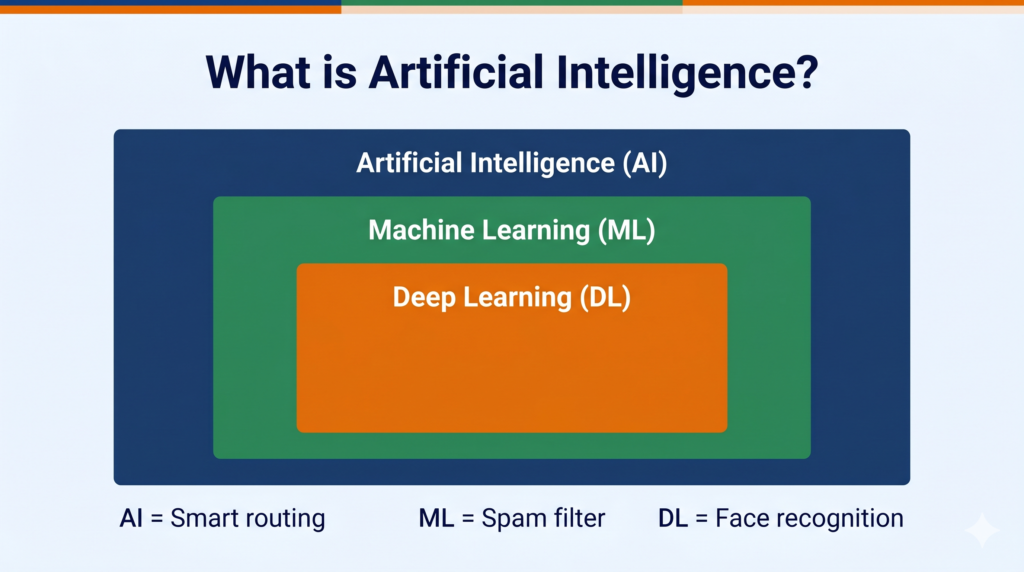
Artificial Intelligence is the ability of a computer system to perform tasks that normally require human intelligence — things like recognising a face, understanding speech, making decisions, or translating a sentence.
A simpler way to think about it: when you ask a question to Google Assistant or when Zomato recommends a restaurant based on what you ordered last week, that is AI at work. The system has learned from data and is making intelligent decisions on its own.
CBSE defines AI as a field of computer science focused on building machines that can learn, adapt and solve problems — the same way humans do, but much faster and at a much larger scale.
📌 Class 9 Focus: You study AI as a skill subject (Code 417). Your Unit 1 is called “AI Reflection, Project Cycle and Ethics” — the AI Reflection part is exactly about understanding what AI is, how it surrounds you, and what the three domains of AI look like.
📌 Class 10 Focus: You revisit AI domains in Unit 1 (“Revisiting AI Project Cycle”) and go deeper into how AI models work in Unit 2 (“Advance Concepts of Modeling in AI”) — including AI vs ML vs DL.
📌 Class 11 Focus: You study this as an elective (Code 843). Your Unit 1 is “Introduction: Artificial Intelligence for Everyone” and it covers the evolution of AI, types of AI, domains, terminologies, and benefits and limitations. Class 11 students should also read our dedicated post on [Introduction to AI for Class 11 — Evolution, Types and Terminologies] once it is published.
The History and Evolution of AI
AI is not new — its roots go back decades. Here is a quick timeline that is helpful for Class 11 exam answers:
1950s — The Beginning: British mathematician Alan Turing asked the question “Can machines think?” and proposed the Turing Test — if a machine can hold a conversation indistinguishable from a human, it is considered intelligent.
1956 — The Word “Artificial Intelligence” is Born: At the Dartmouth Conference in the USA, John McCarthy coined the term “Artificial Intelligence” for the first time.
1960s–1980s — Rule-Based Systems: Early AI systems worked on explicit rules written by humans. These could play chess or solve logic puzzles, but they could not learn from new data.
1990s — Machine Learning Takes Over: Instead of writing rules manually, researchers found that machines could learn patterns from large datasets. This shift gave birth to Machine Learning.
2010s — Deep Learning Revolution: With more data and faster computers, Deep Learning (networks inspired by the human brain) achieved breakthroughs in image recognition, speech and language understanding.
2020s — Generative AI Arrives: Systems like ChatGPT and Google Gemini can generate text, images, audio and video — moving AI from a tool that recognises patterns to one that creates new content.
The Three Domains of AI
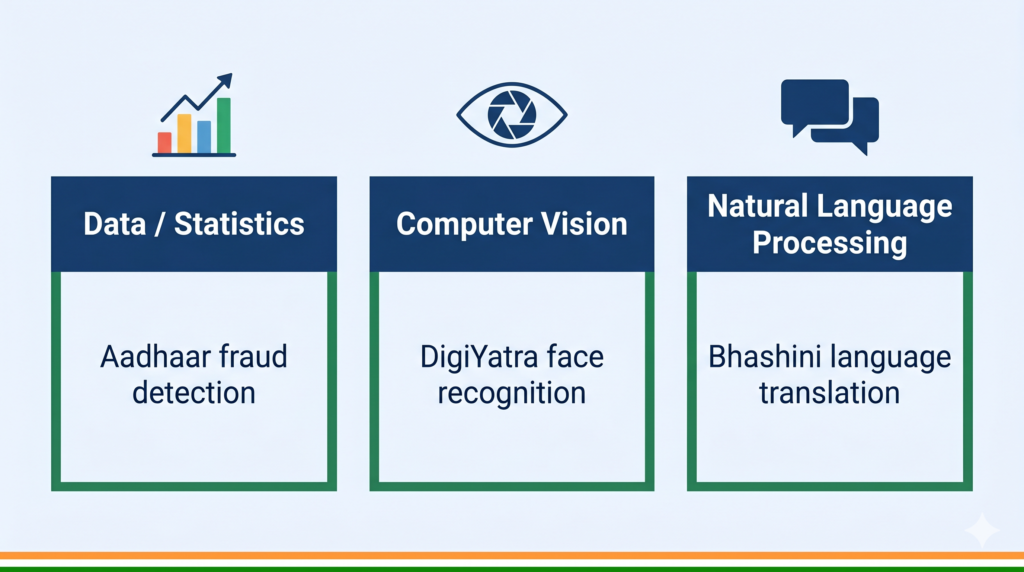
Both Class 9 and Class 10 CBSE syllabuses frame AI through three core domains. These are the three main areas where AI is applied:
Domain 1 — Data and Statistics
This is about using data to find patterns and make predictions. When Netflix recommends a movie or when a bank decides whether to approve a loan, it is using statistical AI — finding patterns in past data to make future decisions.
India example: IRCTC’s recommendation engine studies your past booking patterns and suggests trains you are likely to book. The entire India Stack — Aadhaar, UPI, DigiLocker — uses data-based AI systems to verify identity and process millions of transactions every day.
Domain 2 — Computer Vision (CV)
This is about giving machines the ability to “see” and interpret images and videos. Your phone’s face unlock, traffic cameras counting vehicles, satellite images analysing crop health — all Computer Vision.
India example: ISRO uses Computer Vision to analyse satellite imagery for disaster management. The DigiYatra facial recognition system at airports uses CV to match your face with your Aadhaar or passport.
Domain 3 — Natural Language Processing (NLP)
This is about making machines understand and generate human language — whether written or spoken. Chatbots, Google Translate, voice assistants, spam filters — all NLP.
India example: Bhashini, a government initiative, uses NLP to provide AI-powered translation across 22 Indian languages. It lets farmers access government schemes in their regional language and helps teachers deliver content in Hindi, Tamil, Telugu and more.
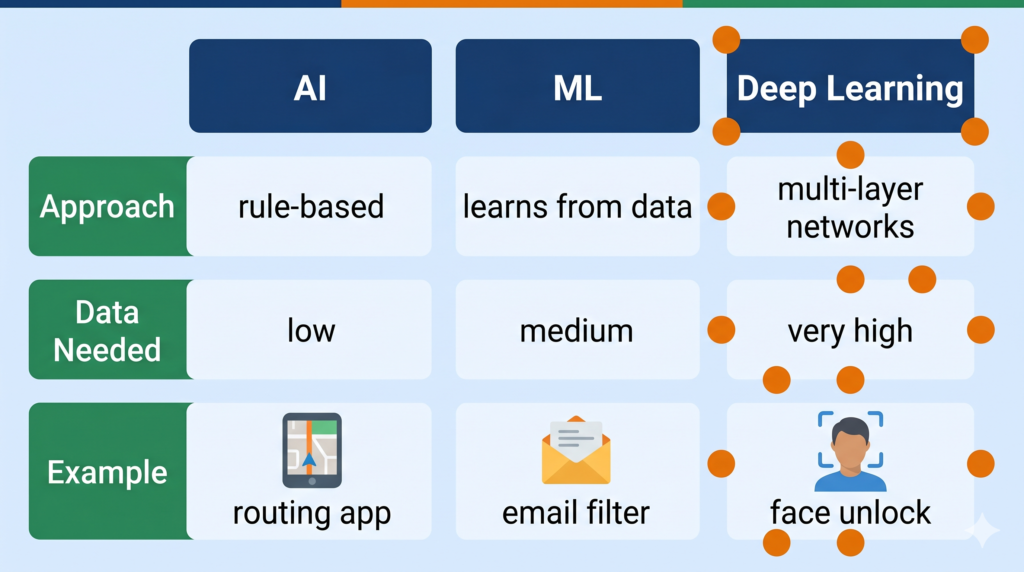
AI vs Machine Learning vs Deep Learning
This is one of the most common exam questions. Here is the exact hierarchy CBSE expects you to understand:
Artificial Intelligence (AI) is the broadest concept — any technique that allows machines to mimic human intelligence. AI is the umbrella.
Machine Learning (ML) is a subset of AI. Instead of programming rules manually, ML systems learn from data. Give them enough examples and they figure out the pattern themselves.
Deep Learning (DL) is a subset of ML. It uses artificial neural networks inspired by the human brain, with many layers of processing. Deep Learning powers image recognition, speech recognition and large language models.
The analogy: Think of it like this — AI is the concept of a smart vehicle. ML is the technology that lets it learn the road. Deep Learning is the advanced engine that makes self-driving possible.
| AI | ML | DL | |
|---|---|---|---|
| Scope | Broadest | Subset of AI | Subset of ML |
| Needs rules? | Yes (rule-based) or No (learning-based) | No — learns from data | No — learns from data |
| Needs lots of data? | Not always | Yes | Yes — massive amounts |
| Example | Spam filter with manual rules | Spam filter that learns | Voice assistant understanding accents |
📌 Class 10 Focus: This AI → ML → DL hierarchy is directly in your Unit 2. CBSE also asks you to distinguish between rule-based approach and learning-based approach — the next section covers this.
Rule-Based vs Learning-Based AI
Rule-Based AI (Traditional AI)
In rule-based AI, a programmer writes every rule the system follows. The machine does exactly what it is told.
Example: A spam filter that blocks emails containing the words “free money” or “click here to claim” — the rules are written by a human. If a new type of spam arrives that does not match any rule, the system cannot catch it.
Limitation: It cannot adapt. If the world changes, someone has to manually update the rules.
Learning-Based AI (Modern AI / Machine Learning)
In learning-based AI, the machine is shown thousands of examples and figures out the patterns on its own. Nobody writes explicit rules.
Example: Gmail’s spam filter uses ML. It has seen millions of spam emails and millions of genuine emails. It learned what makes an email spam — and it keeps updating that knowledge from new data.
Advantage: It improves with more data and adapts to new situations without being reprogrammed.
📌 Class 10 & 11 Exam Tip: A 4-mark question on “Differentiate between rule-based and learning-based AI” is common. Use a table with three rows: definition, how it works, and a real example. Always include an India-relevant example.
Types of AI
CBSE Class 11 Unit 1 expects you to know the types of AI. There are two common classification systems:
By Capability
Narrow AI (Weak AI): AI designed to do one specific task and does it very well. All current AI falls here. Google Translate only translates. Chess engines only play chess.
General AI (Strong AI): A hypothetical AI that can perform any intellectual task a human can do — across domains. This does not exist yet.
Super AI: A hypothetical AI that surpasses human intelligence in every way. This is still in the realm of science fiction.
By Functionality (For Class 11)
Reactive Machines: No memory, no learning from past. Responds only to current input. Example: IBM’s Deep Blue chess computer.
Limited Memory: Can use recent past data to make decisions. Most current ML systems fall here. Example: Self-driving car using recent sensor data.
Theory of Mind: Can understand human emotions and intentions (future AI — not yet achieved).
Self-Aware AI: Has its own consciousness (hypothetical — does not exist).
Domains of AI — Key Terminologies
Here are the terms CBSE expects you to know, especially for Class 11:
Algorithm: A step-by-step set of instructions a computer follows to solve a problem or make a prediction.
Model: The output of training an ML system on data. The model is what gets deployed to make predictions on new data.
Training Data: The dataset used to teach an ML model. Quality and quantity of training data directly affects model performance.
Label: In supervised learning, labels are the correct answers attached to training data. Example: Photos labelled “cat” or “dog.”
Feature: An input variable used by a model to make a prediction. Example: in a house price prediction model, features might include area, number of rooms, location.
Inference: When a trained model is used on new, unseen data to make predictions.
Bias (in AI): When a model gives unfair or inaccurate results because of problems in training data. For example, a facial recognition system trained only on light-skinned faces performing poorly on darker skin tones.
Key Differences and Comparison Table
AI, ML and DL — Side by Side
| Dimension | AI | ML | Deep Learning |
|---|---|---|---|
| Definition | Machines simulating human intelligence | Machines learning from data | Machines learning through neural networks |
| Approach | Rule-based or learning-based | Learning-based | Learning-based (multi-layer) |
| Data requirement | Low to high | Medium to high | Very high |
| Interpretability | High (rule-based) / Medium (ML) | Medium | Low (black box) |
| Example | Google Maps routing | Email spam filter | Face recognition on your phone |
| CBSE grade covered | Class 9, 10, 11 | Class 10, 11 | Class 10 (intro), Class 11, 12 |
Narrow AI vs General AI vs Super AI
| Type | Current Status | Example |
|---|---|---|
| Narrow AI | Exists today | Siri, Alexa, Google Translate |
| General AI | Does not exist | Robots in science fiction |
| Super AI | Hypothetical | Not applicable |
Real-World Applications of AI in India
1. Agriculture — Kisan AI The Indian government’s PM-KISAN scheme uses AI to analyse satellite imagery and soil data to advise farmers on crop selection, irrigation and pest control. Startups like AgroStar use AI-powered chatbots to give farming advice to 3 million farmers in regional languages. SDG 2: Zero Hunger.
2. Healthcare — AI in Government Hospitals AIIMS Delhi uses AI models to analyse medical scans (X-rays, CT scans) for early detection of tuberculosis and diabetic retinopathy. AI can screen thousands of images in the time it would take a doctor to review a few — critical in a country where doctors are scarce in rural areas. SDG 3: Good Health.
3. Education — DIKSHA and NITI Aayog DIKSHA, the government’s national digital infrastructure for school education, is integrating AI to personalise learning content for students across different languages and learning levels. This is exactly the kind of AI that CBSE wants you to appreciate — AI serving social good.
4. Transport — Traffic Management Chennai, Bengaluru and Delhi are using AI-powered traffic signal management systems (from companies like Siemens and local startups) that analyse real-time camera feeds and adjust signal timings to reduce congestion. Pure Computer Vision AI at work.
5. Finance — UPI Fraud Detection The National Payments Corporation of India (NPCI) uses ML models to analyse billions of UPI transactions in real time and flag fraudulent ones — often within milliseconds. Without this AI, UPI fraud would be far more common.
Common Mistakes Students Make in Exams
Mistake 1: Saying ML and AI are the same thing ML is a subset of AI, not a synonym. Every ML system is AI, but not every AI system uses ML (rule-based systems are AI without ML). Always use the hierarchy: AI → ML → DL.
Correct version: “Machine Learning is a subset of Artificial Intelligence where the system learns from data rather than following explicit rules.”
Mistake 2: Confusing the three AI domains Students often write “Data, Machine Learning, and Computer Vision” as the three domains. The CBSE-specified three domains are: Data (Statistics), Computer Vision, and Natural Language Processing.
Correct version: Always state the three domains exactly as CBSE names them.
Mistake 3: Calling current AI “General AI” All AI that exists today — Siri, ChatGPT, facial recognition — is Narrow AI. General AI does not exist. Saying “AI is now smarter than humans in every way” is factually wrong.
Correct version: “Current AI systems are examples of Narrow AI, designed for specific tasks.”
Mistake 4: Forgetting to include an example CBSE marking schemes consistently reward examples. A definition without an example typically gets partial marks. Always include at least one real-world example in any AI answer.
Exam Strategy
For Class 9 (Code 417)
AI Reflection is part of Unit 1 which carries 10 marks (theory). Questions are mostly 1-mark and 2-mark. Focus on: what is AI, the three domains, and examples of AI in daily life.
Typical 1-mark question: “Name the three domains of AI as per your CBSE curriculum.” Answer: Data (Statistics), Computer Vision, and Natural Language Processing.
Typical 2-mark question: “What is Artificial Intelligence? Give one example from your daily life.” Answer: Artificial Intelligence is the ability of a machine to perform tasks that typically require human intelligence, such as learning, decision-making, and recognising patterns. Example: The recommendation system on YouTube that suggests videos based on your watching history is an AI application.
For Class 10 (Code 417)
Unit 2 carries significant marks. Expect a 3-mark or 4-mark question on AI vs ML vs DL, or on rule-based vs learning-based approaches.
Typical 3-mark question: “Differentiate between AI, Machine Learning, and Deep Learning with examples.” Answer structure: Use a table with three columns (AI, ML, DL) and three rows (definition, approach, example). Include one India-relevant example for at least one column.
For Class 11 (Code 843)
Unit 1 carries 4 theory marks + 4 practical marks. Theory questions focus on types of AI, evolution of AI, and terminology. Practical tasks include categorising applications into the three AI domains.
Typical 4-mark question: “Explain the evolution of Artificial Intelligence. How did the approach to AI change from rule-based systems to machine learning?” Answer structure: Start with Turing (1950s) → Rule-Based AI (1960s–1980s) → ML (1990s) → Deep Learning (2010s). Explain the shift in approach: from human-written rules to machine-learned patterns. Conclude with benefits of the learning-based approach.
Try It Yourself — CBSE Activity
Both activities below are specified in the Class 9 CBSE curriculum (Unit 1: AI Reflection). They give you a hands-on feel for the three AI domains — and they are genuinely fun.
Activity 1 — LUIS Smart Home Demo
What it is: LUIS (Language Understanding Intelligent Service) by Microsoft. You type or say a command about controlling lights in a smart home, and the AI interprets your intent.
Link: https://aidemos.microsoft.com/luis/demo
What to do:
- Open the link on any device with internet access.
- Type a command like: “Turn on the living room lights” or “Set the bedroom brightness to 50%.”
- Observe how LUIS interprets your command — it identifies the intent (turn on) and the entity (living room lights).
- Try unusual phrasing and see if it still understands.
- Note down: What domain of AI is this? (NLP — Natural Language Processing.)
Document for your practical file: Note the tool name, what you typed, what LUIS understood, and which AI domain this belongs to.
Activity 2 — The AI Game (Three Domains)
What it is: Three games, one for each AI domain.
Game 1 — Rock, Paper, Scissors AI (Data domain) Link: https://next.rockpaperscissors.ai/ Play against an AI that learns your patterns from your moves. Notice how it starts predicting you better over time — that is a data-based learning system.
Game 2 — Semantris (NLP domain) Link: https://research.google.com/semantris/ Type words associated with the target word. The AI understands meaning and context — not just spelling. Pure NLP.
Game 3 — Quick Draw (Computer Vision domain) Link: https://quickdraw.withgoogle.com/ Draw something and the AI guesses what it is — in real time. This is a neural network trained on millions of human drawings.
What to do: Play all three. For your practical file, note which AI domain each game represents and write two sentences on what you observed.
Quick Revision Box
| Term | One-line definition |
|---|---|
| Artificial Intelligence | The ability of machines to perform tasks requiring human intelligence |
| Machine Learning | A subset of AI where machines learn patterns from data |
| Deep Learning | A subset of ML using multi-layered neural networks |
| Computer Vision | AI domain that enables machines to interpret images and video |
| Natural Language Processing | AI domain that enables machines to understand and generate human language |
| Data (Statistics) | AI domain that uses data analysis and patterns to make predictions |
| Rule-Based AI | AI that follows manually programmed rules |
| Learning-Based AI | AI that learns patterns from data without explicit rules |
| Narrow AI | AI designed for one specific task — all current AI is Narrow AI |
| General AI | Hypothetical AI that can perform any human task — does not exist yet |
| Algorithm | Step-by-step instructions a computer follows |
| Model | The trained system that makes predictions on new data |
| Training Data | Data used to teach an ML model |
| Bias | Unfair model outcomes due to problems in training data |
Practice Questions
2-Mark Question
Q: What is Artificial Intelligence? How is it different from a regular computer program?
Model Answer: Artificial Intelligence is the ability of a computer system to perform tasks that typically require human intelligence — such as recognising speech, making decisions, or understanding language. A regular computer program follows fixed instructions written by a programmer and can only do exactly what it is told. An AI system, especially a machine learning system, learns from data and can adapt to new situations without being explicitly reprogrammed. Example: A traditional calculator always adds numbers the same way, but a fraud detection AI adapts as fraudsters change their tactics. (2 marks)
4-Mark Question
Q: Explain the difference between Artificial Intelligence, Machine Learning, and Deep Learning with suitable examples. (Class 10/11)
Model Answer: Artificial Intelligence (AI) is the broadest concept — it refers to any technique that makes machines simulate human intelligence. Machine Learning (ML) is a subset of AI where machines learn from data rather than following rules. Deep Learning (DL) is a subset of ML that uses artificial neural networks with many layers, inspired by the human brain.
The key difference lies in approach and data requirements. Rule-based AI follows manual rules and cannot improve on its own. ML learns patterns from training data and improves with more examples. DL uses layered neural networks to identify very complex patterns — like recognising faces or understanding spoken language — but requires very large datasets.
Examples: An email spam filter using keyword rules is rule-based AI. Gmail’s spam filter that learns from millions of flagged emails is ML. Google Photos recognising your face in new photos uses Deep Learning. (4 marks)
MCQ
Q: Which of the following is NOT a domain of AI as specified in the CBSE curriculum?
a) Computer Vision b) Natural Language Processing c) Robotics d) Data (Statistics)
Answer: c) Robotics (Robotics is an application area that may use AI, but the three CBSE-specified AI domains are: Data/Statistics, Computer Vision, and Natural Language Processing.)
Frequently Asked Questions
Q1. Is ChatGPT an example of Narrow AI or General AI? ChatGPT is Narrow AI — it is extremely good at generating and understanding text, but it cannot drive a car, recognise your face, or make a cup of tea. It has one domain of strength. General AI, which can do anything a human can do, does not exist yet. CBSE wants you to know this distinction clearly.
Q2. My Class 9 book says AI has three domains, but my Class 10 book also talks about supervised learning, reinforcement learning — are these different things? Good observation. The three domains (Data, CV, NLP) describe what AI is applied to — the real-world areas. Supervised, unsupervised, and reinforcement learning describe how AI learns — the methods. Both frameworks are part of your CBSE syllabus, just in different units. Think of it this way: a fraud detection system uses Data as its domain and supervised learning as its method.
Q3. What is the difference between a rule-based chatbot and an AI chatbot? A rule-based chatbot follows a decision tree written by a programmer. If you ask something outside its programmed paths, it says “I don’t understand.” An AI chatbot (like Bhashini’s voice assistant or ChatGPT) uses NLP and machine learning — it has been trained on vast amounts of conversation data and can understand varied phrasing, context, and even sentiment. Class 11 students build a simple chatbot as a CBSE practical activity.
Q4. What is AI bias and why does CBSE include it in the syllabus? AI bias happens when a model’s training data does not represent all groups fairly, leading to unfair or inaccurate outputs. A hiring AI trained mainly on male resumes might rank women lower even for equally qualified candidates. CBSE includes this because AI impacts real people, and students need to be responsible AI practitioners. This topic is assessed in Class 9 (AI Bias and AI Access), Class 10 (ethics), and in depth in Class 11 Unit 8 (AI Ethics and Values).
Q5: Not in your syllabus but good to know — Can AI ever become more intelligent than all humans combined? This is called Artificial Superintelligence (ASI) and it is purely hypothetical. Some researchers like Nick Bostrom warn it could be risky if it happened without proper safety measures. Others like Andrew Ng argue the more immediate concern is making current Narrow AI fair, accessible and well-governed. As a future AI practitioner, thinking about these questions is exactly what CBSE wants to encourage through your ethics units.
Action Plan
Exam Practice Checklist
- [ ] I can define AI, ML and DL in my own words and give one example of each
- [ ] I can name the three CBSE AI domains and give an India-relevant application for each
- [ ] I can explain rule-based vs learning-based AI with a clear real-world contrast
- [ ] I can name the types of AI (Narrow, General, Super) and state which ones exist today
- [ ] I know at least 8 key terms from the Quick Revision Box above
- [ ] I have attempted the 2-mark and 4-mark practice questions without looking at the answers
- [ ] I have played at least one of the three AI Games and can describe what domain it represents
Interactive Tools — Try the AI Game
The CBSE curriculum officially recommends these tools for your AI Reflection unit. Try all three:
- Rock, Paper, Scissors AI: https://next.rockpaperscissors.ai/
- Semantris: https://research.google.com/semantris/
- Quick Draw: https://quickdraw.withgoogle.com/
Document your experience in your practical file — which domain does each game belong to, and what did you observe?
Project Idea — AI Domains Around Me
Goal: Map AI applications in your city or daily life to the three CBSE domains.
Step 1: List 9 AI applications you interact with or have heard about (Zomato recommendations, IRCTC booking suggestions, Google Translate, FASTag, CCTV face detection at metro stations, etc.).
Step 2: Categorise each one into Data, Computer Vision, or NLP. If it could belong to more than one, explain why.
Step 3: Present your findings as a poster or a three-column table titled “AI Domains Around Me.” Add which SDG each application connects to (e.g., DigiYatra → SDG 9: Industry, Innovation and Infrastructure).
This is a strong portfolio activity for Class 9 and Class 11 students.