Your practical file is done, your Capstone Project is ready — but there is one more thing standing between you and full marks in Class 11 AI practical: the Viva Voce.
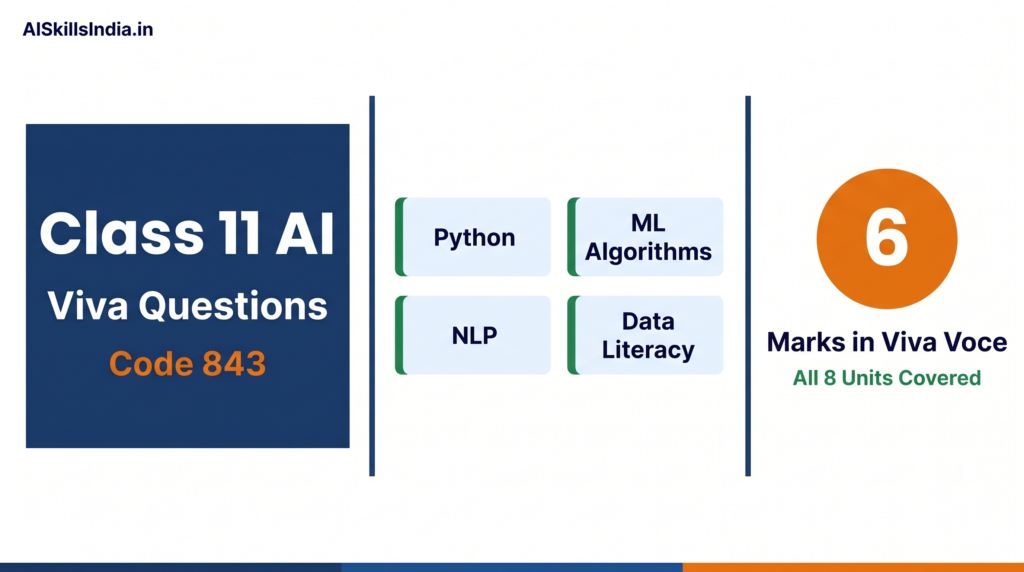
Worth 6 marks and based on your Practical File and Capstone Project, the viva is the moment your examiner tests whether you actually understand what you built — not just copied. This guide gives you the most important questions across all 8 units of CBSE AI Code 843, with clear model answers you can study and adapt.
What You’ll Learn
- The most likely viva questions from every Class 11 AI unit
- Exactly how to structure short, confident answers
- What examiners look for in Capstone Project vivas
- How to handle Python and ML questions without memorising code
How the Class 11 AI Viva Works
The Viva Voce in Class 11 AI (Code 843) carries 6 marks under Part C (Practical Work). According to the CBSE 2025-26 curriculum, the viva is based on two things: your Practical File and your Capstone Project. The examiner will typically spend 8–12 minutes asking you questions drawn from whatever you have submitted.
Most examiners follow a pattern: they start with your project (what problem did you solve, why did you choose it), then move to your practical file activities (can you explain what you did), and occasionally test a concept from the theory units. Being clear, brief, and honest scores better than long rehearsed speeches.
Unit 1 — Introduction to AI: Expected Viva Questions
Q1. What is Artificial Intelligence? Give one example. AI is the ability of machines to perform tasks that would normally require human intelligence — like recognising speech, making decisions, or learning from data. Example: Google Maps using AI to predict traffic and suggest the fastest route.
Q2. What are the three domains of AI? Give one application for each. The three domains are Computer Vision (example: face unlock on phones), Natural Language Processing (example: Google Translate), and Robotics/Automation (example: industrial robots in car manufacturing). These map to the classification activity in the Class 11 CBSE Student Handbook.
Q3. What is the difference between Narrow AI and General AI? Narrow AI is designed for one specific task and cannot do anything outside that task — like a spam filter or a chess engine. General AI, which does not exist yet, would be able to learn and perform any intellectual task that a human can.
Unit 2 — Unlocking Your Future in AI: Expected Viva Questions
Q4. What AI job roles are in demand today? Common roles include AI Engineer, Data Scientist, Machine Learning Engineer, NLP Specialist, and Computer Vision Engineer. For the practical file activity, CBSE asks students to identify companies hiring for AI positions and list the technical and soft skills required — make sure you can speak to what you found.
Q5. What soft skills does an AI professional need? Communication, critical thinking, problem-solving, and collaboration. Technical skills alone are not enough — an AI engineer at a company like Infosys or TCS also needs to explain complex models to non-technical teams.
Unit 3 — Python Programming: Expected Viva Questions
Q6. What is a DataFrame in Pandas? How do you create one? A DataFrame is a two-dimensional table-like data structure in Pandas with rows and columns, similar to a spreadsheet. You create one using pd.DataFrame() and can pass a dictionary, a list of lists, or a CSV file as input.
Q7. What does df.isnull().sum() do? It counts the number of missing (null) values in each column of the DataFrame. This is the first step in data cleaning — you need to know where gaps exist before deciding how to fill or remove them.
Q8. What is NumPy used for? NumPy is used for numerical computation in Python. It provides the ndarray data structure for fast array operations and mathematical functions like mean, standard deviation, and matrix multiplication — all of which are used in Machine Learning.
📌 Note for your viva: If your practical file includes Python programs, the examiner may ask you to explain a specific line from your code. Always be ready to walk through your own programs.
Unit 4 — Capstone Project: Expected Viva Questions
Q9. What problem did you choose for your Capstone Project? Why? (Your answer will be specific to your project. Structure it like this:) “I chose [problem statement] because it aligns with SDG [number] — [SDG name]. The problem affects [target users], and we found that existing solutions do not address [specific gap].”
Q10. What is an Empathy Map? Did you create one for your project? An Empathy Map is a Design Thinking tool that captures what the user says, thinks, does, and feels. It helps you understand your users’ pain points before building a solution. For our project, we mapped the needs of [describe your user] and found that [key insight].
Q11. What is the AI Project Cycle? The AI Project Cycle has five stages: Problem Scoping, Data Acquisition, Data Exploration, Modelling, and Evaluation. Each stage feeds into the next — you cannot build a good model without first defining the problem clearly and collecting clean data.
Unit 5 — Data Literacy: Expected Viva Questions
Q12. What is the difference between mean, median, and mode? Mean is the average of all values. Median is the middle value when data is sorted. Mode is the most frequently occurring value. When data has extreme outliers — like income data — median is a better measure than mean because it is not pulled by very high or very low values.
Q13. What is data pre-processing? Why is it important? Data pre-processing is cleaning and transforming raw data before it is fed into a model. It includes handling missing values, removing duplicates, normalising data, and encoding categorical variables. Without pre-processing, even a good algorithm will produce poor results — “garbage in, garbage out.”
Q14. What is a scatter plot used for? A scatter plot shows the relationship between two numerical variables. If points cluster along a diagonal, it suggests a correlation. In the Class 11 practical, you would have used Matplotlib to plot scatter graphs — be ready to describe what your data showed.
Unit 6 — Machine Learning Algorithms: Expected Viva Questions
Q15. What are the three types of Machine Learning? Supervised Learning (the model learns from labelled data — example: email spam detection), Unsupervised Learning (the model finds patterns in unlabelled data — example: customer segmentation), and Reinforcement Learning (the model learns by receiving rewards or penalties — example: a game-playing AI).
Q16. What is Linear Regression? Give a real-world example. Linear Regression finds the best straight line that fits the relationship between an input variable and an output variable. Example: predicting a student’s final exam score based on the number of hours studied. In the practical, you demonstrated this in MS Excel using the CBSE-prescribed method.
Q17. What is the k-Nearest Neighbour (kNN) algorithm? kNN classifies a new data point by looking at the k nearest points in the training data and assigning the majority class. Example: if k=3 and two of the three nearest neighbours are “spam,” the new email is classified as spam. The value of k must be chosen carefully — too small leads to noise, too large leads to bias.
Q18. What is clustering? How is k-Means different from kNN? Clustering groups similar data points together without labels — it is unsupervised. k-Means assigns each point to one of k clusters based on distance to the cluster centre. kNN, by contrast, is a supervised classification algorithm — it needs labelled training data. The “k” in both refers to a number chosen by the user, but they solve completely different problems.
Unit 7 — Leveraging Linguistics and Computer Science (NLP): Expected Viva Questions
Q19. What is Natural Language Processing (NLP)? NLP is the branch of AI that enables computers to understand, interpret, and generate human language. Applications include chatbots, machine translation, sentiment analysis, and voice assistants like Alexa or Google Assistant.
Q20. What is a chatbot? Which platforms did you use in the practical? A chatbot is a program that simulates human conversation using NLP. In the Class 11 practical, CBSE prescribes building a chatbot on platforms like Google Dialogflow, Botsify, or Botpress. The ice-cream ordering chatbot activity is a common practical file entry — be ready to walk through the intent, entities, and responses you defined.
Q21. What is the difference between syntax and semantics in NLP? Syntax refers to the grammatical structure of language — whether a sentence is formed correctly. Semantics refers to the meaning of that sentence. “Colourless green ideas sleep furiously” is syntactically correct (grammatically valid) but semantically meaningless.
Unit 8 — AI Ethics and Values: Expected Viva Questions
Q22. What are the key ethical concerns in AI? The main concerns are bias (AI models can reflect and amplify human prejudices), privacy (large-scale data collection raises consent issues), transparency (many AI decisions are difficult to explain), and job displacement (automation replacing human roles). The Moral Machine and “Survival of the Best Fit” activities in the practical help explore these trade-offs.
Q23. What is algorithmic bias? Give an example. Algorithmic bias occurs when an AI system produces systematically unfair results due to flawed training data or model design. Example: a hiring algorithm trained on historical data from male-dominated industries may unfairly rank female applicants lower — not because of capability, but because of bias in the data it learned from.
Q24. What is your view on AI ethics based on your Capstone Project? Did your project raise any ethical concerns? (Prepare a genuine answer tied to your actual project.) Example: “Our project used health data to predict disease risk. We considered privacy — we made sure no personally identifiable information was included in our dataset. We also discussed whether the model’s predictions could cause anxiety if shown directly to patients without medical context.”
Capstone Project Viva — Common Questions
Q25. Walk me through your Capstone Project. Use this structure: (1) Problem Statement — what challenge did you address and which SDG does it connect to? (2) Target Users — who did you design for, and what did your Empathy Map reveal? (3) Data — what data did you collect and how? (4) Model/Solution — what approach did you use? (5) Testing — how did you evaluate whether it works? (6) Reflection — what would you do differently?
Q26. Which SDG does your project align with? How? Be specific. “Our project aligns with SDG 3 — Good Health and Well-being — because we built a model to detect early signs of anaemia from routine school health data collected in rural districts.” Vague answers like “it helps people” will not score well.
Q27. What tools or platforms did you use to build your project? Name the specific tools: Python (with which libraries?), Orange Data Mining, TensorFlow Playground, or a chatbot platform. Explain briefly what each tool was used for in your project.
Quick Revision Box
| Term | One-Line Definition |
|---|---|
| Viva Voce | Oral examination based on Practical File and Capstone Project — 6 marks |
| Supervised Learning | ML where model learns from labelled input-output data pairs |
| k-Means Clustering | Unsupervised algorithm that groups data into k clusters by proximity |
| Empathy Map | Design Thinking tool capturing user’s thoughts, feelings, actions, and words |
| Pre-processing | Cleaning and transforming raw data before feeding it to an ML model |
Practice Questions
Q1 (2-mark): Differentiate between kNN and k-Means clustering with one example each.
Model Answer: kNN is a supervised classification algorithm that assigns a label to a new point based on the labels of its k nearest neighbours in training data (example: classifying an email as spam or not spam). k-Means is an unsupervised clustering algorithm that groups unlabelled data into k clusters based on distance to cluster centres (example: grouping customers by purchasing behaviour). kNN needs labelled data; k-Means does not.
Q2 (MCQ): The Viva Voce component in Class 11 AI (Code 843) is based on:
a) Only the theory exam
b) Only the Practical File
c) Both the Practical File and the Capstone Project ✅
d) Only the IBM SkillsBuild certification
FAQ
Q1. How long is the Class 11 AI viva, and who conducts it? The viva is typically 8–15 minutes per student. It is conducted by the external examiner during the practical examination. The examiner will have your Practical File in hand and may refer to specific activities you submitted.
Q2. My Capstone Project is simple. Will I be penalised? No — complexity is not the criterion. The examiner is checking whether you understand what you built and can explain your design decisions. A simple project explained confidently scores better than a complex project you cannot explain. Focus on the “why” behind your choices.
Q3. What if I don’t know the answer to a viva question? Say honestly: “I am not fully sure about this, but based on what I know, I think it works like this…” Partial knowledge expressed clearly is better than guessing confidently and being wrong. Examiners appreciate students who know their limits.