You’ve studied the chapters. You’ve made your notes. But until you sit with an actual question paper and work through it, you don’t really know where you stand.
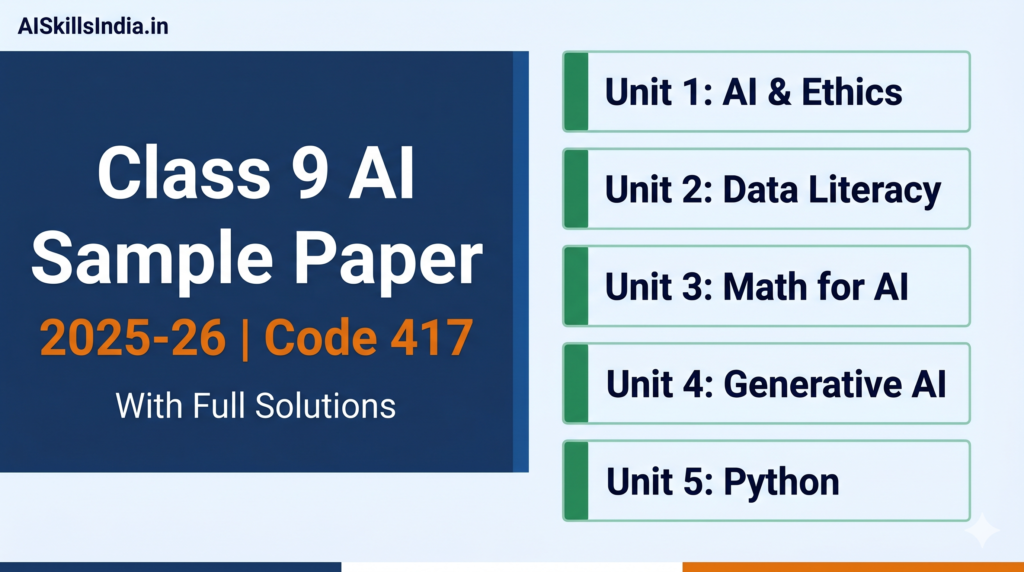
This sample paper for Class 9 AI (CBSE Code 417, session 2025-26) is built from the official CBSE curriculum — covering all five units in Part B, with the same question types and marks distribution your board examiner will use. Full model answers are included for every question.
What You’ll Learn
- What the Class 9 AI theory paper looks like and how marks are distributed
- How to write model answers for 1-mark, 2-mark, and 4-mark questions
- Which topics carry the most weight in your exam
Class 9 AI Exam Pattern 2025-26 (Code 417)
Before attempting the paper, understand the pattern from the CBSE 2025-26 curriculum PDF:
Theory Paper: 50 Marks
| Section | Part | Marks |
|---|---|---|
| Part A | Employability Skills (Units 1–5) | 10 |
| Part B | Subject Specific Skills (Units 1–5) | 40 |
| Total | 50 |
Subject Specific Skills — Unit-wise Marks (Part B):
| Unit | Topic | Marks |
|---|---|---|
| Unit 1 | AI Reflection, Project Cycle and Ethics | 10 |
| Unit 2 | Data Literacy | 10 |
| Unit 3 | Math for AI (Statistics & Probability) | 7 |
| Unit 4 | Introduction to Generative AI | 5 |
| Unit 5 | Introduction to Python | 8 |
| Total | 40 |
Practical Work: 50 Marks Practical File (15 programs) — 15 marks | Practical Examination — 15 marks | Viva Voce — 5 marks | Project Work — 15 marks
📌 Important: This sample paper covers the Theory component only. For practical and viva preparation, refer to the dedicated Class 9 AI Practical and Viva posts on this site.
Sample Paper — Class 9 AI (Code 417) 2025-26
Time Allowed: 2 Hours | Maximum Marks: 50
Instructions: Read all questions carefully. Section A has 1-mark questions. Section B has 2-mark questions. Section C has 4-mark questions. Attempt all questions.
SECTION A — Part A: Employability Skills (10 Marks)
(1 mark each)
Q1. What does the abbreviation “ICT” stand for?
Q2. Which of the following is an example of Green Skill? a) Typing faster b) Reducing paper usage in school projects c) Using social media effectively d) Writing code in Python
Q3. What is self-management?
Q4. Give one example of entrepreneurial thinking in everyday student life.
Q5. Communication between two people where one listens actively and the other speaks is called ________ communication.
Q6–Q10. (These marks are distributed across communication, ICT, and green skills questions — exact questions depend on the Employability Skills curriculum downloaded from the CBSE website, which is separate from the AI subject PDF.)
SECTION B — Part B: Subject Specific Skills (40 Marks)
Unit 1 — AI Reflection, Project Cycle and Ethics (10 Marks)
Q11 (1 mark). Name the three domains of AI.
Q12 (1 mark). What does the “P” in the AI Project Cycle stand for?
Q13 (2 marks). What is AI bias? Give one real-world example.
Q14 (2 marks). Explain the difference between a supervised task and an unsupervised task in AI. Give one example of each.
Q15 (4 marks). Describe the five stages of the AI Project Cycle. Why is Problem Scoping considered the most important stage?
Unit 2 — Data Literacy (10 Marks)
Q16 (1 mark). What is a dataset?
Q17 (1 mark). Which type of graph is best suited to show the change in temperature over seven days?
Q18 (2 marks). What is the difference between structured and unstructured data? Give one example of each.
Q19 (2 marks). What are two problems that can affect data quality? How can each problem be addressed?
Q20 (4 marks). You have collected data on the number of hours 10 students studied per week and their exam scores. (a) What type of graph would you use to show the relationship between study hours and scores? (b) What pattern would you expect to see, and what does it suggest?
Unit 3 — Math for AI (Statistics & Probability) (7 Marks)
Q21 (1 mark). The marks scored by five students are: 45, 60, 72, 60, 83. What is the mode?
Q22 (2 marks). A bag contains 3 red balls and 7 blue balls. What is the probability of picking a red ball? What is the probability of picking a ball that is not red?
Q23 (4 marks). The ages of students in a class are: 14, 13, 15, 14, 16, 13, 14, 15. Calculate the mean and median age. Show your working clearly.
Unit 4 — Introduction to Generative AI (5 Marks)
Q24 (1 mark). What is Generative AI?
Q25 (2 marks). Give two differences between Generative AI and traditional AI models.
Q26 (2 marks). Mention two ethical concerns related to the use of Generative AI tools by students.
Unit 5 — Introduction to Python (8 Marks)
Q27 (2 marks). Write a Python program to calculate and print the area of a rectangle when length = 10 and breadth = 5.
Q28 (2 marks). What is the output of the following code?
python
num = [23, 12, 5, 9, 65, 44]
print(num[1])
print(num[-1])
Q29 (4 marks). Write a Python program that takes a student’s name and marks in three subjects as input, calculates the average, and prints whether the student has Passed (average ≥ 40) or Failed.
SOLUTIONS — Full Model Answers
Section A — Employability Skills
A1. ICT stands for Information and Communication Technology.
A2. b) Reducing paper usage in school projects. (Green Skills are habits and practices that reduce environmental impact.)
A3. Self-management is the ability to regulate one’s own behaviour, emotions, and time — including setting goals, staying organised, and managing stress effectively.
A4. Example: Identifying that students in your neighbourhood need tutoring and starting an informal study group to help them — recognising a need and taking initiative to address it.
A5. Two-way (or interpersonal) communication.
Section B — Subject Specific Skills
A11. The three domains of AI are: Computer Vision, Natural Language Processing (NLP), and Robotics/Automation. (Note: CBSE uses the framing of Data, Computer Vision, and NLP as the three AI domains in the Class 9 Student Handbook — ensure your answer matches how your teacher has taught it.)
A12. The “P” in the AI Project Cycle stands for Problem Scoping (the first stage).
A13. AI bias occurs when an AI system produces unfair or inaccurate results because the data it was trained on reflects existing human biases or is not representative. Example: A facial recognition system trained mostly on images of lighter-skinned people may perform poorly when identifying people with darker skin tones — because the training data was not diverse enough.
A14.
- Supervised learning: The model is trained on labelled data — each input has a known correct output. Example: training a model on images labelled “cat” or “dog” so it can classify new images.
- Unsupervised learning: The model is given data without labels and must find patterns on its own. Example: grouping customers by purchasing behaviour without telling the model how many groups to form.
A15. The five stages of the AI Project Cycle are:
- Problem Scoping — Define what problem you are solving, who it affects, and what success looks like. This is the most important stage because a poorly defined problem leads to building the wrong solution — no matter how good the data or model is.
- Data Acquisition — Collect the data needed to train the AI model. This includes identifying sources, gathering data ethically, and ensuring it is representative.
- Data Exploration — Analyse the collected data to understand its structure, identify missing values, spot outliers, and visualise patterns using graphs.
- Modelling — Choose and train an AI model on the prepared data. Test different approaches to find what works best for the problem.
- Evaluation — Measure how well the model performs using appropriate metrics. If the performance is unsatisfactory, return to earlier stages and improve.
Problem Scoping is most important because it determines the direction of every other stage. If you define the wrong problem, all subsequent effort is wasted.
A16. A dataset is a structured collection of related data — typically organised as rows and columns — used for analysis or for training an AI model. Example: a spreadsheet of student names, ages, and test scores.
A17. A line graph is best suited to show how temperature changes over seven days, because it clearly shows trends and changes over time.
A18.
- Structured data is organised in a defined format — usually rows and columns — making it easy to search and analyse. Example: an Excel spreadsheet of student marks.
- Unstructured data has no fixed format and is harder to process directly. Example: a paragraph of text, an audio recording, or a photograph.
A19.
- Missing values — Some entries in the dataset may be blank or incomplete. Solution: fill missing values using the mean/median of that column, or remove the incomplete row if it is not critical.
- Duplicate entries — The same record may appear more than once. Solution: identify and remove duplicate rows before analysing the data.
A20. (a) A scatter plot would be most appropriate, because it shows the relationship between two numerical variables — study hours on the x-axis and exam score on the y-axis. (b) You would expect to see an upward trend — as hours studied increase, exam scores tend to increase. This pattern suggests a positive correlation between study time and performance. It does not prove that studying causes better scores, but it does suggest a relationship worth investigating.
A21. The mode is 60 — it appears twice, more than any other value.
A22. Total balls = 3 red + 7 blue = 10 balls.
- Probability of picking a red ball = 3/10
- Probability of picking a ball that is not red = 7/10
(These two probabilities add up to 10/10 = 1, which confirms the answer is correct.)
A23. Data set (sorted): 13, 13, 14, 14, 14, 15, 15, 16 — 8 values.
Mean = (14 + 13 + 15 + 14 + 16 + 13 + 14 + 15) ÷ 8 = 114 ÷ 8 = 14.25 years
Median — 8 values, so the median is the average of the 4th and 5th values. 4th value = 14, 5th value = 14. Median = (14 + 14) ÷ 2 = 14 years
A24. Generative AI is a type of AI that can create new content — such as text, images, audio, or video — by learning patterns from large amounts of existing data. Examples include ChatGPT (text) and Stable Diffusion (images).
A25.
| Traditional AI | Generative AI | |
|---|---|---|
| Purpose | Analyses or classifies existing data | Creates new data (text, images, audio) |
| Output | A decision, label, or prediction | A newly generated piece of content |
A26.
- Deepfakes and misinformation — Generative AI can create realistic fake images or videos of people saying or doing things they never said or did, which can be used to spread false information.
- Academic dishonesty — Students may use AI tools to write their essays or complete assignments without developing their own understanding, which undermines genuine learning.
A27.
python
length = 10
breadth = 5
area = length * breadth
print("Area of rectangle:", area)
Output: Area of rectangle: 50
A28.
12
44
Explanation: num[1] is the second element (index starts at 0) = 12. num[-1] is the last element = 44.
A29.
python
name = input("Enter student name: ")
m1 = float(input("Enter marks in Subject 1: "))
m2 = float(input("Enter marks in Subject 2: "))
m3 = float(input("Enter marks in Subject 3: "))
avg = (m1 + m2 + m3) / 3
print("Student:", name)
print("Average marks:", avg)
if avg >= 40:
    print("Result: Passed")
else:
    print("Result: Failed")
Note: This uses basic Python — input(), float(), arithmetic, if-else — all within the Class 9 CBSE syllabus.
Quick Revision Box
| Concept | One-Line Summary |
|---|---|
| AI Project Cycle | 5 stages: Problem Scoping → Data Acquisition → Exploration → Modelling → Evaluation |
| Mode | Most frequently occurring value in a dataset |
| Structured Data | Data in rows and columns (e.g. spreadsheet) |
| Generative AI | AI that creates new content — text, images, audio |
| Probability | Likelihood of an event = favourable outcomes ÷ total outcomes |
Practice Questions
Q1 (2-mark): What is the difference between AI bias and data quality issues? Give one example of each.
Model Answer: AI bias is a systematic unfairness in a model’s output — often caused by training data that does not represent all groups equally (example: a hiring model that scores female applicants lower because it was trained on data from a historically male-dominated industry). A data quality issue is a technical problem with the data itself — missing values, duplicates, or errors — that degrades model performance regardless of fairness (example: a dataset of student marks with blank entries for several students). Bias is a fairness problem; data quality is an accuracy problem.
Q2 (MCQ): A bag has 4 green and 6 yellow marbles. The probability of picking a yellow marble is: a) 4/10 b) 6/4 c) 6/10 ✅ d) 4/6
FAQ
Q1. Is this sample paper exactly what will come in my exam? No — this is a practice paper based on the CBSE 2025-26 syllabus and exam pattern. The actual question paper is set by CBSE and will differ. The value of this paper is in practising question types, managing time, and checking your understanding of the marking scheme. Always refer to official CBSE sample papers released on cbse.gov.in for the most authoritative preparation material.
Q2. How much time should I spend on each section in the exam? A rough guide: Employability Skills (Section A, 10 marks) — 15–20 minutes. Unit 1–4 questions — 45–50 minutes. Python questions (Unit 5) — 20–25 minutes. Leave 10 minutes to review your answers. Python programs take longer to write than theory answers, so don’t save them for last.
Q3. Do I need to memorise Python programs for the theory exam? For the theory paper, you are expected to write short programs (not memorise long ones) and interpret code output — as shown in Q28 and Q29. Focus on understanding how input(), print(), conditionals, and lists work. Memorising exact programs is less useful than understanding the logic.