
Starting Your CBSE Class 10 AI Journey? Read This First.
Hey there! 👋
So you’ve picked Artificial Intelligence for Class 10 CBSE as your skill subject. Smart choice! Whether you chose it because “AI sounds cool” or because your school made you, I’m here to make sure you don’t just survive – you THRIVE.
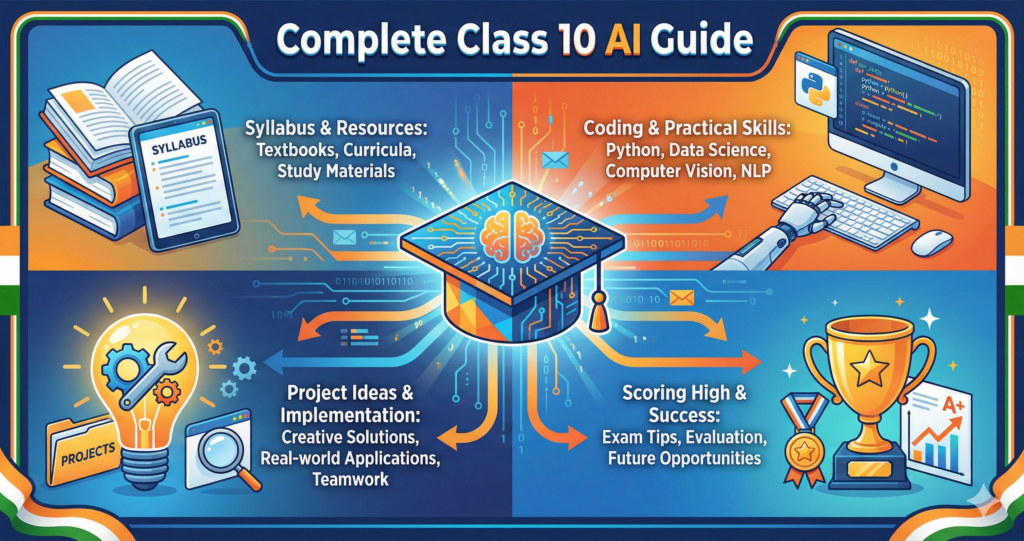
This is the complete Class 10 AI CBSE guide that covers absolutely everything: from understanding the syllabus structure to acing your board exams, from Python practicals to project work, and from “what is this subject even about?” to “how do I score 45+ marks?”
By the end of this guide, you’ll have a crystal-clear roadmap for the entire year. No confusion, no panic, just a solid plan.
Quick reality check: This subject gives you 100 marks (50 theory + 50 practical) that count toward your percentage. Unlike some skill subjects that are just “additional,” Class 10 AI CBSE can actually REPLACE a failed subject under CBSE rules. More on that later.
Why CBSE Introduced AI in Class 10 (And Why It Matters to You)
The Big Picture
CBSE partnered with IBM and introduced AI as a skill subject because:
- Future-ready skills: AI jobs are growing 40% annually in India
- Practical learning: Unlike theory-heavy subjects, this is hands-on
- Problem-solving: You’ll build actual AI projects, not just memorize
- College advantage: Many tech colleges give preference to AI students
What Makes Class 10 AI Different
This isn’t Computer Science. You won’t spend the year writing algorithms on paper.
This is AI literacy: Understanding how machines learn, building models using no-code tools (Orange Data Mining), and creating solutions for real-world problems.
The cool part? You can build a disease diagnosis system or sentiment analyzer WITHOUT being a coding genius. That’s the power of modern AI tools.
The Complete CBSE Class 10 AI Syllabus Breakdown
Understanding the structure is 50% of success. Let me break down the Class 10 AI CBSE syllabus into digestible chunks.
The Two-Part Structure
The syllabus has TWO major parts:
PART A: Employability Skills (10 marks)
- Communication Skills
- Self-Management
- ICT Skills
- Entrepreneurial Skills
- Green Skills
PART B: Subject-Specific AI Content (40 marks)
- This is where the actual AI concepts live
- 7 units covering everything from project cycle to Python
PART C: Practical Work (50 marks)
- Practical file with 15 programs
- Practical exam
- Project work
- Viva voce
Part B: Unit-wise Deep Dive (This is the Important Part!)
Let me break down what you’ll actually study in Class 10 AI CBSE:
Unit 1: Revisiting AI Project Cycle & Ethical Frameworks (7 marks)
What you’ll learn:
- The 5 stages of AI Project Cycle (Problem Scoping → Data Acquisition → Data Exploration → Modeling → Evaluation)
- Three AI domains: Data Science, Computer Vision, Natural Language Processing
- Ethical frameworks for AI (Bioethics, fairness, transparency, bias)
Why it matters: This is your foundation. Every project you build will follow this cycle.
Exam pattern:
- 5 MCQs (1 mark each)
- 1 short answer (2 marks)
- 1 long answer (4 marks)
Pro tip: The 4Ws Problem Canvas (What, Who, Where, Why) is GUARANTEED to appear. Practice drawing it.
Unit 2: Advanced Concepts of Modeling in AI (11 marks)
What you’ll learn:
- Difference between AI, ML, and Deep Learning
- Types of machine learning: Supervised, Unsupervised, Reinforcement
- Classification vs Regression models
- Neural Networks (this confuses everyone – I’ll help you understand it simply)
- How AI makes decisions
Why it matters: Highest marks from a single unit. Master this = score 45+.
Exam pattern:
- 8 MCQs (1 mark each)
- 3 short answers (2 marks each)
Danger zone: Neural Networks and CNN are abstract. Use visual learning (I’ll link resources below).
Unit 3: Evaluating Models (10 marks)
What you’ll learn:
- Why evaluation matters
- Train-test split
- Confusion Matrix (True Positive, False Positive, etc.)
- Accuracy, Precision, Recall, F1 Score
- Bias and transparency issues
Why it matters: Confusion Matrix alone is worth 4-6 marks. Learn this ONE topic well and you’re golden.
Exam pattern:
- 5 MCQs
- 1 short answer
- 1 long answer (usually: “Given this confusion matrix, calculate all metrics”)
Unit 4: Statistical Data (Practical Only)
What you’ll learn:
- Using Orange Data Mining tool (no-code AI)
- Analyzing datasets
- Building classification and regression models
- Interpreting results
Why it matters: This is your practical exam savior. Orange is SO much easier than coding from scratch.
Exam pattern:
- Not tested in theory
- 15 marks in practical exam
- You’ll be given a dataset, asked to build a model, and explain results
Essential skill: Learn Orange BEFORE exam month. It takes 2-3 hours to become comfortable.
Unit 5: Computer Vision (4 marks)
What you’ll learn:
- How computers “see” images
- Pixels, resolution, RGB vs grayscale
- Convolutional Neural Networks (CNN)
- Feature extraction, convolution operation
- Real-world applications (face recognition, object detection)
Why it matters: Questions are theoretical but require understanding visual concepts.
Exam pattern:
- 3 MCQs
- 1 short answer
Cool practical: You’ll use Lobe.ai or Teachable Machine to build an image classifier (like a plant disease detector).
Unit 6: Natural Language Processing (8 marks)
What you’ll learn:
- How computers understand human language
- Text processing: tokenization, bag of words, TF-IDF
- Sentiment analysis
- Chatbots (script bot vs smart bot)
Why it matters: NLP projects are easier to explain in viva (everyone understands “analyze if a review is positive or negative”).
Exam pattern:
- 5 MCQs
- 1 short answer
- 1 long answer
Project idea: Sentiment analysis of movie reviews or Twitter data (easy + impressive).
Unit 7: Advanced Python (Practical Only)
What you’ll learn:
- Jupyter Notebook basics
- NumPy (arrays, mean, median, mode)
- Matplotlib (line charts, scatter plots)
- Reading CSV files
- Basic image processing with OpenCV
Why it matters: Your 15-program practical file comes from this.
Exam pattern:
- Not tested in theory
- 15 marks in practical exam (you’ll write/debug code)
- 15 marks for practical file
The CBSE Class 10 AI Marking Scheme (Where Marks Come From)
Understanding this is CRITICAL for strategy.
Theory Paper (50 marks) – 2 hours
| Section | Type | Questions | To Answer | Marks |
|---|---|---|---|---|
| Part A | Employability Skills | 5 MCQs | All 5 | 10 marks |
| Part B | AI Subject MCQs | 24 MCQs | Any 20 | 20 marks |
| Part B | Short Answer (2m each) | 6 questions | Any 4 | 8 marks |
| Part B | Long Answer (4m each) | 5 questions | Any 3 | 12 marks |
| TOTAL | 50 marks |
Key insights:
- ✅ You have CHOICES – don’t panic if one question is tough
- ✅ MCQs are 30% of theory marks (easy scoring)
- ✅ Employability Skills are easy 10 marks (don’t skip!)
Practical Exam (50 marks) – Conducted by school
| Component | Marks | What It Is |
|---|---|---|
| Practical File | 15 | Your notebook with 15 programs + outputs |
| Practical Exam | 15 | Examiner gives you a task (Orange/Python) |
| Project Work | 10 | Your capstone AI project |
| Viva Voce | 10 | Questions about your project + concepts |
| TOTAL | 50 |
Key insights:
- ✅ Practical file is FREE 15 marks (just maintain it properly)
- ✅ Project work: Start early, choose simple problem
- ✅ Viva: Confidence matters more than perfection
The Exact Exam Pattern You’ll Face
Theory Paper Structure (Actual Board Exam)
You’ll receive a question paper with:
Section A – Employability Skills (10 marks):
- 5 questions with assertion-reasoning format
- Example: “Assertion: Entrepreneurship involves risk. Reason: Starting a business has uncertainties.”
- All 5 are compulsory
Section B – Subject Specific (40 marks):
Part 1: MCQs (20 marks)
- 24 MCQs given, answer any 20
- Topics from all 7 units
- 1 mark each, no negative marking
Part 2: Short Answer (8 marks)
- 6 questions given, answer any 4
- 2 marks each
- Expected answer length: 20-30 words
Part 3: Long Answer (12 marks)
- 5 questions given, answer any 3
- 4 marks each
- Expected answer length: 100-150 words
Pro tip: In MCQs, always attempt all 24 (even if guessing). No negative marking means zero downside!
How to Score 45+ in CBSE Class 10 AI (Strategic Study Plan)
The High-Yield Topics (Study These First!)
Based on past 3 years of board papers, these topics appear EVERY year:
Guaranteed Questions (20+ marks):
- Confusion Matrix calculations (4-6 marks)
- AI Project Cycle 4Ws (2-4 marks)
- Types of Machine Learning (2-4 marks)
- Neural Networks basics (2-4 marks)
- Supervised vs Unsupervised learning examples (2 marks)
Frequently Asked (10+ marks): 6. Precision vs Recall scenarios (2-4 marks) 7. CNN layers explanation (2 marks) 8. Bag of Words / TF-IDF (2 marks) 9. Ethical issues in AI (bias, transparency) (2-4 marks) 10. Train-test split concept(2 marks)
Master these 10 topics = Guaranteed 30+ marks in theory alone.
The 12-Week Study Plan
Weeks 1-4: Foundation Building
- Week 1-2: Units 1 & 2 (Project Cycle, ML Types, Neural Networks)
- Week 3-4: Unit 3 (Evaluation Metrics – spend extra time on Confusion Matrix)
- Parallel: Start Orange Data Mining practice (1 hour/week)
Weeks 5-8: Domains & Practicals
- Week 5: Unit 5 (Computer Vision basics, CNN)
- Week 6: Unit 6 (NLP, text processing)
- Week 7: Python programming (write all 15 programs)
- Week 8: Complete practical file, start project
Weeks 9-11: Project & Integration
- Week 9-10: Complete AI project (data collection, model, documentation)
- Week 11: Orange workflows for all three domains (practice 5+ times)
- Parallel: Solve MCQs (50+ questions per week)
Week 12: Revision & Mock Tests
- Days 1-3: Theory revision (formula sheets, MCQs)
- Days 4-5: Practical revision (Orange + Python)
- Days 6-7: Full mock tests (theory + practical)
The Practical Exam: What Actually Happens
Many students panic about practicals. Here’s exactly what to expect:
Before Exam Day
Your school will:
- Submit your practical file to CBSE (date varies by school)
- Schedule practical exam (usually 2-3 weeks before theory boards)
- Assign an external examiner
You must prepare:
- ✅ Practical file with 15 programs (neat, indexed, signed)
- ✅ Project report (printed, bound)
- ✅ Confidence in Orange Data Mining
- ✅ Ability to explain your project
On Exam Day (Step-by-Step)
Duration: 30-45 minutes per student
Part 1: Practical File Check (5 minutes)
- Examiner flips through your file
- Checks if all 15 programs are there
- Asks 1-2 basic questions (“What does this program do?”)
Part 2: Practical Task (15-20 minutes)
- You’re given EITHER:
- Option A: Orange task (“Build a model to classify this data”)
- Option B: Python task (“Write a program to calculate mean/median” or “Read this CSV and plot a graph”)
Example Orange Task:
“I’m giving you a dataset of iris flowers. Use Orange to build a classification model that predicts the species. Show me the confusion matrix and tell me the accuracy.”
Example Python Task:
“Write a Python program using NumPy to calculate the mean and standard deviation of this array: [45, 67, 89, 23, 56, 78]”
Part 3: Project Presentation (10 minutes)
- Show your project
- Explain: Problem → Data → Model → Results
- Demonstrate if possible (even if using Orange screenshots)
Part 4: Viva Questions (10 minutes)
- Questions about your project
- General concepts from syllabus
- Practical applications
Sample viva questions:
- “Why did you choose this algorithm?”
- “What is overfitting? Did your model overfit?”
- “Explain the difference between classification and regression.”
- “What is the confusion matrix showing?”
How to Score Full Marks in Practicals
For Practical File (15 marks):
- ✅ All 15 programs present
- ✅ Neat handwriting or printout
- ✅ Proper index and page numbers
- ✅ Every program has: Title, Code, Output, Explanation
- ✅ Teacher signature on each program
For Practical Exam (15 marks):
- ✅ Complete the task in time
- ✅ Explain your steps clearly
- ✅ Handle errors calmly (debugging shows understanding)
- ✅ Show understanding, not just memorization
For Project (10 marks):
- ✅ Clear problem statement (aligned with SDGs is bonus)
- ✅ Real dataset (not made-up numbers)
- ✅ Working model (even simple is fine)
- ✅ Professional report format
For Viva (10 marks):
- ✅ Confident body language
- ✅ Admit if you don’t know (don’t bluff)
- ✅ Connect answers to your project
- ✅ Use correct terminology
Get project templates: 10 Ready AI Projects
Project Work: How to Choose & Execute
Your project is 10 marks, but more importantly, it’s your showcase piece. Choose wisely.
The Perfect Project Formula
Good projects have these 4 qualities:
- Simple problem: Don’t try to cure cancer with AI
- Available data: You can find/collect it easily
- Explainable: You understand how it works
- Impressive: Solves a real problem
10 Project Ideas (Easy to Hard)
Beginner Level:
- Spam Email Classifier (using Bag of Words)
- Movie Review Sentiment Analysis (positive/negative)
- Student Grade Predictor (based on study hours, attendance)
- Flower Species Classification (Iris dataset – classic)
Intermediate Level: 5. Face Mask Detector (Computer Vision with Teachable Machine) 6. Crop Disease Identifier(image classification) 7. Fake News Detector (NLP with TF-IDF) 8. Heart Disease Prediction (classification with medical data)
Advanced Level: 9. Coral Bleaching Detection (Computer Vision with Orange) 10. Student Dropout Prediction(regression with multiple features)
Project Report Format (Follow This Exactly)
Your report should have these sections:
1. Cover Page
- Project Title
- Your Name, Class, Roll Number
- School Name
- Session: 2025-26
2. Certificate
- School principal’s certificate
- Teacher’s signature
3. Acknowledgement
- Thank teachers, parents (keep it short)
4. Table of Contents
5. Introduction (1 page)
- What problem are you solving?
- Why is it important?
- SDG connection (bonus points)
6. Problem Scoping (1-2 pages)
- 4Ws Canvas (What, Who, Where, Why)
- Goal statement
7. Data Acquisition (1 page)
- Where did you get data?
- How many samples?
- What features?
8. Data Exploration (1-2 pages)
- Data visualization (graphs, charts)
- Insights from data
9. Modeling (2-3 pages)
- Which algorithm did you use? (Classification/Regression)
- Why this algorithm?
- Screenshots of Orange workflow or Python code
10. Evaluation (1-2 pages)
- Confusion matrix
- Accuracy, Precision, Recall
- Is the model good enough?
11. Conclusion (1 page)
- What did you learn?
- Future improvements
12. References
- List datasets, tools, websites used
Total: 10-15 pages (not including code printouts)
Special Topic: Can AI Replace a Failed Subject?
This is a common question, and the answer is YES, with conditions.
The CBSE Replacement Rule
According to CBSE guidelines:
If you FAIL in one main subject (Science, Math, Social Science), AND you PASS in AI:
- Your AI marks will replace the failed subject for pass percentage calculation
- You still qualify for promotion to Class 11
- You get a “Pass” certificate
Example:
- You score 30/100 in Math (FAIL)
- You score 80/100 in AI (PASS)
- CBSE considers you PASSED overall
- Your percentage is calculated using AI marks instead of Math
BUT there’s a catch:
- You still need to appear for Math compartment exam (usually July)
- Some Class 11 streams (like Science with Math) might still require Math pass
- Check your target stream requirements
Common Mistakes Students Make (And How to Avoid Them)
Mistake #1: Ignoring Part A (Employability Skills)
Why it’s bad: You’re throwing away FREE 10 marks.
Solution: Spend 2 hours before exam revising Part A. It’s common sense + basic definitions.
Key topics:
- Communication barriers (physical, semantic, psychological)
- SMART goals (Specific, Measurable, Achievable, Relevant, Time-bound)
- Types of entrepreneurs (solo, partnership, family)
- Green skills (3Rs: Reduce, Reuse, Recycle)
Mistake #2: Memorizing Without Understanding
Why it’s bad: Viva will expose you. Examiners ask “Why?” not “What?”
Solution: For every concept, understand:
- What problem does it solve?
- How does it work (basic idea)?
- Real-world example?
Example: Don’t just memorize: “Precision = TP / (TP + FP)” Understand: “Precision tells me: when I predict positive, how often am I correct? High precision = fewer false alarms.”
Mistake #3: Starting Project in Exam Month
Why it’s bad: Good projects need iteration. You can’t do quality work in 1 week.
Solution:
- September-October: Choose topic, collect data
- November-December: Build model, iterate
- January: Complete report, prepare viva
Starting in February = guaranteed stress + subpar project.
Mistake #4: Focusing Only on Theory
Why it’s bad: Practicals are 50% marks. Many students lose 15-20 marks here.
Solution:
- Practice Orange 5+ times BEFORE exam
- Run every Python program yourself (don’t just copy)
- Explain concepts out loud (teach a friend)
Mistake #5: Ignoring MCQ Strategy
Why it’s bad: MCQs are 30 marks. Poor strategy = lost marks.
Solution:
- Attempt ALL 24 MCQs (no negative marking)
- If stuck: eliminate obviously wrong options, then guess
- Don’t overthink – first instinct is often correct
- Time management: 30 seconds per MCQ = 12 minutes for all MCQs
The Last Week Strategy (Battle-Tested Plan)
You have 7 days before theory exam. Here’s the optimal plan:
Day 7 (One Week Before):
Morning (3 hours): Confusion Matrix, Precision, Recall, F1 Afternoon (2 hours): AI Project Cycle (4Ws, stages)Evening (2 hours): 50 MCQs practice
Day 6:
Morning (3 hours): ML types, Classification vs Regression, Decision Trees Afternoon (2 hours): Neural Networks, CNN basics Evening (2 hours): Employability Skills (all units)
Day 5:
Morning (3 hours): NLP (Bag of Words, TF-IDF, Sentiment Analysis) Afternoon (2 hours): Computer Vision (Pixels, RGB, Convolution) Evening (2 hours): 50 MCQs practice
Day 4:
Morning (3 hours): Train-test split, Overfitting, Bias Afternoon (2 hours): Orange Data Mining practice (build 2-3 models) Evening (2 hours): Python revision (run 5-7 key programs)
Day 3:
Full-length Mock Test (2 hours):
- Attempt a complete theory paper
- Time yourself strictly
- Check answers, note weak areas
Evening (3 hours): Revise weak areas from mock test
Day 2:
Morning (2 hours): Formula sheet revision (write formulas 5 times) Afternoon (2 hours): Diagram practice (Confusion Matrix, Neural Network, 4Ws Canvas) Evening (2 hours): Previous year board papers (2-3 papers)
Day 1 (Night Before):
Morning (2 hours): Light revision – MCQs only Afternoon: Relax, watch AI explanation videos Evening: Read formula sheet once, sleep early
NO NEW TOPICS on Day 1! Your brain needs consolidation time.
FAQ: Your Questions Answered
Q1: Is Class 10 AI difficult?
A: It’s DIFFERENT, not difficult. If you’re expecting traditional math/science, you’ll struggle. But if you embrace the practical, hands-on nature, it’s actually easier than subjects like Math or Science.
Difficulty level: 6/10 (compared to Math: 8/10, Science: 7/10)
Q2: Do I need to be good at coding?
A: Not really! The Python part is basic (arrays, charts, reading files). If you can understand logic, you can code these programs. Plus, 50% of practicals use Orange Data Mining, which is NO CODE.
Q3: Can I score 90+ in AI?
A: Yes, but it’s rare. Most toppers score 80-85. Why? Because practicals involve subjective evaluation (project quality, viva performance). But 45+ (90%) is very achievable.
Realistic targets:
- With moderate effort: 35-40 (70-80%)
- With dedicated effort: 40-45 (80-90%)
- With exceptional effort: 45-48 (90-96%)
Q4: What if I fail in AI?
A: You can appear for compartment exam (usually in July). BUT – if you fail AI AND pass another subject, that subject can cover for AI in percentage calculation (reverse of the replacement rule).
Better question: How to NOT fail? Follow this guide, maintain practical file, attempt all questions. Failing is nearly impossible if you put in basic effort.
Q5: Which project is easiest?
A: Sentiment Analysis (NLP) or Iris Flower Classification (Data Science). Both have:
- Readily available datasets
- Simple logic (positive/negative sentiment OR classify flower species)
- Easy to explain in viva
- Can be done in Orange in 2 hours
Avoid: Anything with “prediction” in healthcare (too complex for Class 10 level unless you really understand it).
Q6: Is AI better than IT/Computer Science as skill subject?
A: AI is newer and more relevant to current industry trends. IT/CS teach basics (MS Office, networking) which you might already know. AI teaches cutting-edge concepts that colleges and employers value.
Choose AI if: You want to learn something genuinely new and future-focused. Choose IT if: You want a guaranteed easy subject with familiar content.
Full comparison: AI vs IT vs CS
Q7: Do I need a powerful computer for AI practicals?
A: No! Orange Data Mining and Teachable Machine work on ANY computer (even 4GB RAM). Python might be slow on very old laptops, but it’ll still work.
Minimum requirements:
- Windows 7 or later / macOS / Linux
- 4GB RAM
- 50GB free space
- Internet (for downloading tools)
Q8: Can I do AI without taking coaching?
A: Absolutely! This subject is designed to be self-learnable with the right resources. Use:
- Your school textbook
- Free online tools (Orange, Teachable Machine)
- This guide + AISkillsIndia.in articles
- YouTube tutorials
Coaching might help IF: You’re completely lost and your school teacher is unavailable. But it’s not necessary.
Your Action Plan: Next Steps
Okay, you’ve read this far (impressive dedication!). Here’s what to do NOW:
This Week:
Day 1 (Today):
- Download Orange Data Mining
- Download CBSE Class 10 AI syllabus PDF
- Bookmark this guide
Day 2:
- Watch 1-2 Orange Data Mining tutorials
- Create your practical file (buy register, make index)
- List 3 project ideas you’re interested in
Day 3:
- Read Unit 1 from textbook (AI Project Cycle)
- Practice drawing 4Ws Canvas 3 times
- Solve 10 MCQs from Unit 1
Day 4-7:
- Start Unit 2 (Modeling concepts)
- Write your first Python program in Jupyter
- Research datasets for your chosen project
This Month:
Week 1-2:
- Complete Units 1, 2, 3 (theory + notes)
- Write 5 Python programs in practical file
- Practice Orange with 2 sample datasets
Week 3-4:
- Complete Units 5, 6 (CV + NLP)
- Finalize project topic
- Start data collection for project
Next 3 Months:
Month 1-2: Complete syllabus, practical file, start project Month 3: Complete project, revision, mock tests Month 4 (Exam month): Final revision, practical exam, theory boards
Final Words: You’ve Got This! 💪
Look, CBSE Class 10 AI might seem overwhelming right now – new subject, unfamiliar concepts, practical exams, project work. But here’s the truth:
Thousands of students just like you have scored 40+ marks in AI. They’re not geniuses. They just:
- Started early (not in exam month)
- Understood concepts (not just memorized)
- Practiced tools (Orange, Python)
- Chose simple projects (not overambitious)
- Asked for help when stuck
You have this ENTIRE guide. You have all the resources linked. You have a clear roadmap.
All you need now is execution.
Start today. Even if it’s just 30 minutes. Install Orange. Read one unit. Write one program.
Small steps, consistent effort, massive results.
Good luck with your Class 10 AI CBSE journey! 🚀
If this guide helped you, share it with your classmates. Let’s make AI easier for everyone.