Your Class 12 AI exam explicitly asks you to “differentiate between Generative AI and Discriminative AI and identify their use cases.” Your Class 11 syllabus covers types of AI and ML in Unit 1 and Unit 6. If you cannot clearly explain what makes Generative AI different from the traditional AI you studied before, you are leaving marks on the table. This post draws the line clearly — with a full comparison table, real examples, and model exam answers.
What You’ll Learn
- The core difference between Traditional AI and Generative AI
- Generative AI vs Discriminative AI — the distinction CBSE specifically tests
- Real-world examples that work in exam answers for both Class 11 and Class 12
What Is Traditional AI?
Before Generative AI existed, most AI systems were built to analyse, classify, or predict based on existing data. These systems are often called Traditional AI or Discriminative AI — they draw a boundary between categories and tell you which side something falls on.
A spam filter that decides whether an email is spam or not spam is Traditional AI. A loan approval system that classifies an application as approved or rejected based on past data is Traditional AI. A recommendation system that predicts whether you will like a particular song is Traditional AI. In all these cases, the AI is taking an input and mapping it to a known output category or prediction — it is not creating anything new.
📌 Class 11 note: This connects to your Unit 6 (Machine Learning Algorithms) — supervised learning models like Linear Regression, KNN, and classification algorithms are all forms of Traditional / Discriminative AI. They learn from labelled data to make predictions.
📌 Class 12 note: Your Unit 7 explicitly uses the term “Discriminative model” as the counterpart to “Generative model.” CBSE expects you to know both terms and use them correctly.
What Is Generative AI?
Generative AI refers to AI systems that can create new content — text, images, audio, video, or code — that did not exist before. Instead of classifying or predicting from a fixed set of outputs, a Generative AI model learns the underlying patterns and distributions in the training data and then generates entirely new examples that follow those same patterns.
When you ask Google Gemini to write a poem about climate change, it is not retrieving a poem from a database — it is generating a brand new sequence of words that follows the patterns of poetry it learned during training. When Canva’s AI generates a banner image from your text description, it is synthesising pixels into a new image, not selecting from a gallery. This is the fundamental shift that Generative AI represents.
The Core Difference — One Table to Memorise
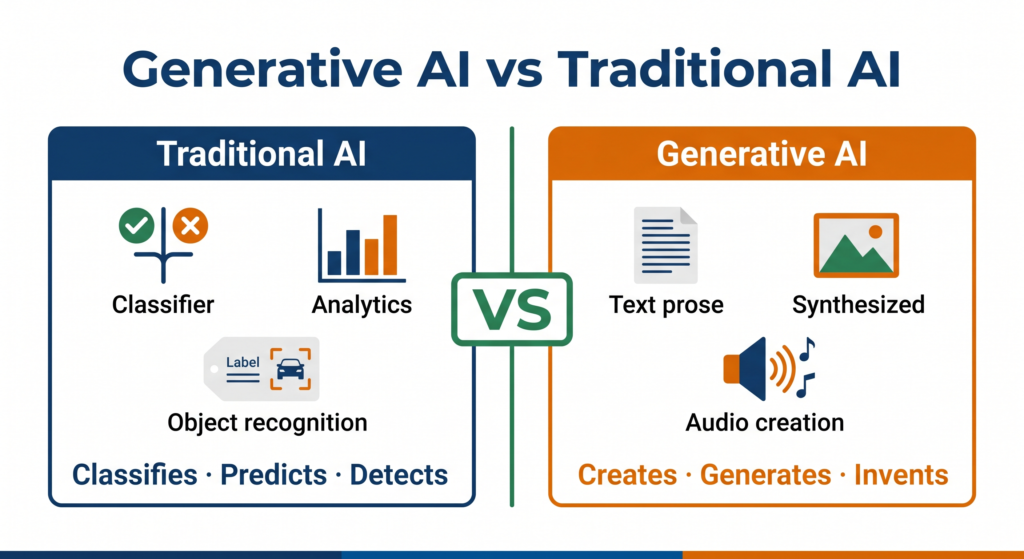
This is the comparison CBSE tests. Learn each row.
| Aspect | Traditional AI (Discriminative) | Generative AI |
|---|---|---|
| Primary function | Classify, predict, or detect | Create new content |
| Output type | Label, category, or score | Text, image, audio, video, code |
| What it learns | Decision boundaries between categories | Underlying distribution and patterns of data |
| Training goal | Minimise prediction error | Learn to generate realistic new samples |
| Example task | “Is this email spam?” | “Write a professional email” |
| Example model | Linear Regression, KNN, SVM | ChatGPT, Gemini, DALL-E, Midjourney |
| India example | Aadhaar identity verification system | Bhashini language text generation |
| Data requirement | Labelled datasets (with correct answers) | Large unlabelled or semi-labelled datasets |
| Exam keyword | Discriminative model | Generative model |
Generative AI vs Discriminative AI — Explained Simply
The terms Generative and Discriminative are the exact vocabulary your CBSE Class 12 Unit 7 uses. Here is an analogy that makes the difference stick.
Imagine you are learning to recognise cats and dogs from photographs.
A Discriminative model studies the differences — ears, snout, tail — and learns to draw a line between cat photos and dog photos. When you show it a new photo, it says “cat” or “dog.” It cannot draw you a cat. It only separates.
A Generative model studies everything about what cats look like — their fur texture, whiskers, body shape, eye colour, typical poses — and builds an internal mental model of “cat-ness.” Once it has learned this, it can generate a new image of a cat that has never existed. It creates.
Both types of models are important. Discriminative models are faster to train, more accurate for classification tasks, and easier to evaluate. Generative models are more flexible and powerful for creative tasks, but harder to train and evaluate.
Side-by-Side — Traditional AI Tasks vs Generative AI Tasks
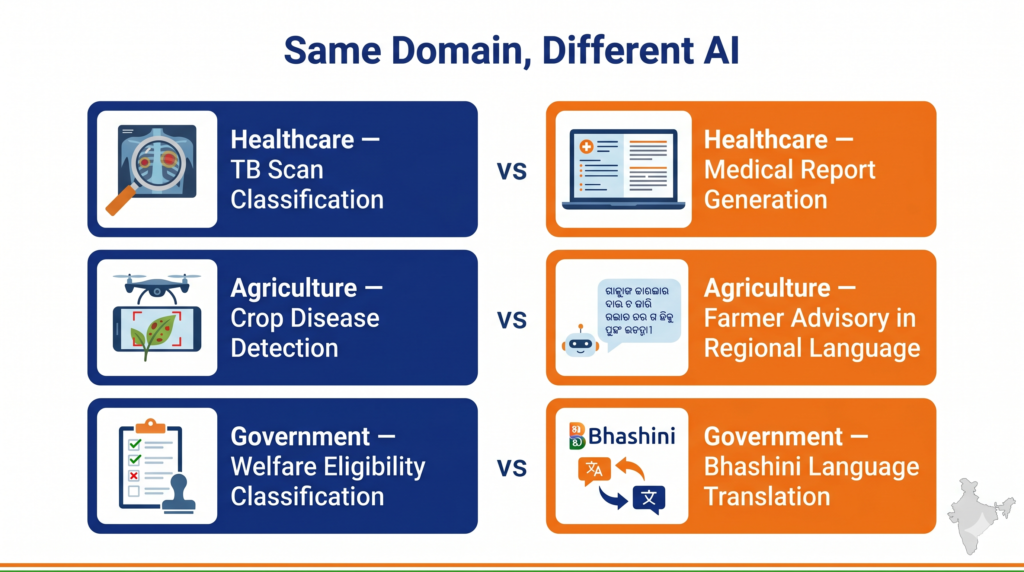
Here is how the same domain looks different depending on which type of AI is used.
Healthcare: Traditional AI — A model trained on thousands of X-rays classifies whether a scan shows signs of tuberculosis (yes/no). India’s National TB Elimination Programme has piloted AI classification tools for exactly this purpose. Generative AI — A model generates a synthetic medical report summarising a patient’s scan findings in plain language for a doctor to review quickly.
Agriculture: Traditional AI — A crop disease detection model classifies whether a leaf image shows early blight, late blight, or healthy tissue (a classification task). Generative AI — An AI assistant generates personalised advisory text for a farmer in their regional language, explaining what to spray and when, based on the detected disease.
Education: Traditional AI — A grading model predicts whether a student’s essay meets the required standard (pass/fail or score prediction). Generative AI — An LLM-based tutor like the one in AISkillsIndia.in’s app generates a customised explanation of a concept the student is struggling with.
Government and public services: Traditional AI — NITI Aayog’s AI-based systems classify beneficiary eligibility for welfare schemes based on socioeconomic data. Generative AI — Bhashini generates real-time text translations of government announcements into regional Indian languages, making public services accessible to all citizens.
Where Generative AI Fits in the Broader AI Family
Understanding this hierarchy helps you answer “explain the relationship between” questions.
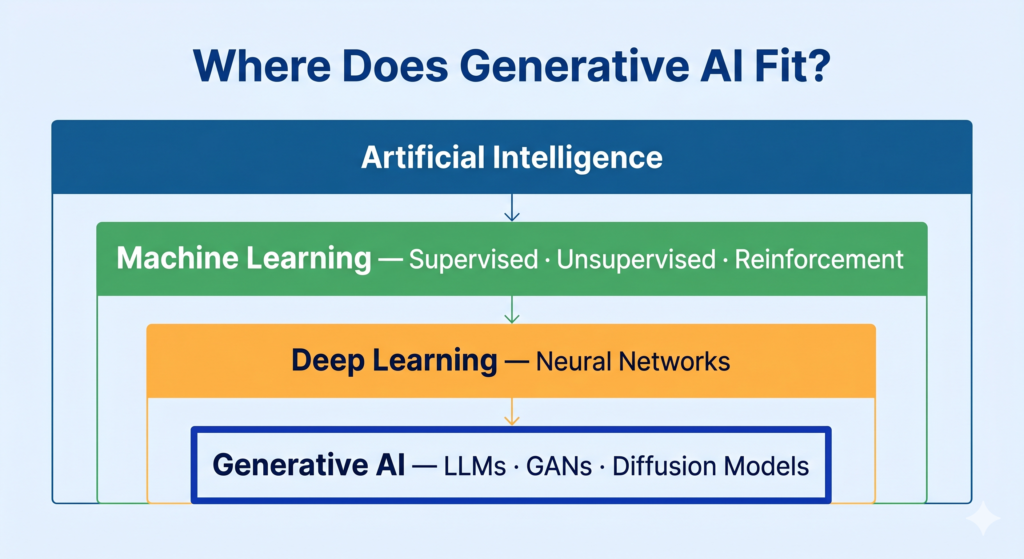
Artificial Intelligence is the broadest category — any system that simulates intelligent behaviour.
Inside AI, Machine Learning covers systems that learn from data rather than following fixed rules. Traditional ML algorithms (KNN, Linear Regression, Decision Trees) sit here.
Inside Machine Learning, Deep Learning uses neural networks with many layers. Both Traditional AI (CNNs for image classification) and Generative AI (Transformer-based LLMs) use deep learning.
Generative AI is a specific application of Deep Learning focused on content creation. It uses architectures like Transformers (for text), GANs — Generative Adversarial Networks (for images), and Diffusion Models (for high-quality image and video generation).
So Generative AI is not a replacement for Traditional AI — it is an addition to the AI toolkit, serving different purposes.
📌 Class 11 note: Your Unit 1 covers Types of AI and AI Terminologies. This hierarchy — AI → ML → Deep Learning → Generative AI — is directly relevant to your Unit 1 exam questions on AI types and domains.
Try It Yourself — CBSE Activity
Your CBSE Class 12 Unit 7 activities require hands-on comparison of AI tools. Here is a structured activity that directly produces practical file content on this topic.
Activity: Compare a Discriminative Task and a Generative Task Using AI Tools
Step 1 — Discriminative task: Go to Google’s Teachable Machine (teachablemachine.withgoogle.com). Train a simple image classification model using your webcam — two classes (e.g., “hand open” and “hand closed”). Test it on new images. Observe: the model gives you a probability score for each class. It is classifying, not creating.
Step 2 — Generative task: Open Google Gemini (gemini.google.com). Give it the prompt: “Describe a scene from a future Indian city where AI is used to manage traffic and public transport.” Observe: the model generates entirely new descriptive text that did not exist before your prompt.
Step 3 — In your practical file, write one paragraph comparing what each tool did. Use the terms “discriminative model” and “generative model.” Note the input each tool received and what type of output it produced.
What to record: Screenshots of both tasks. A two-row table in your practical file — one row for the Teachable Machine result, one row for the Gemini output — with columns: Tool, Task Type, Input, Output, Model Type.
Common Exam Mistakes
Mistake 1 — Treating “Traditional AI” and “Discriminative AI” as completely separate terms In CBSE context, these are used interchangeably. When the question says “Traditional AI,” it means rule-based or supervised learning systems. When it says “Discriminative AI,” it means the same category framed in contrast to Generative AI. Use both terms in your answer to show you understand the vocabulary.
Mistake 2 — Writing that Generative AI is “better” than Traditional AI Neither type is universally better. Discriminative models are more accurate for classification tasks. Generative models excel at content creation. A 4-mark answer that acknowledges both use cases will always score higher than one that declares a winner.
Mistake 3 — Forgetting to include examples CBSE Unit 7’s learning outcome says “identify their use cases.” An answer with no examples will lose at least 1 mark on a 4-mark question. Always include one example of each type.
Mistake 4 — Confusing GANs with LLMs Both are Generative AI, but they work differently. GANs (Generative Adversarial Networks) are primarily used for image generation — a generator and a discriminator compete. LLMs use Transformer architecture and are primarily used for text. You do not need to know the deep technical details for CBSE, but knowing these names shows exam awareness.
Exam Strategy
For a 2-mark question (“Differentiate between Generative AI and Traditional AI”): Write one clear sentence for each type, ending with a contrasting example. “Traditional AI classifies or predicts from existing data — for example, a spam filter that labels emails as spam or not spam. Generative AI creates new content — for example, Google Gemini generating original text responses from a prompt.”
For a 4-mark question (“Explain Generative AI and Discriminative AI with examples and use cases”): Structure: definition of each (1 mark each) + one use case per type with an India example (1 mark each).
For a Class 11 exam question on types of AI or ML: Frame your answer around the AI → ML → Deep Learning → Generative AI hierarchy. Mention that traditional supervised/unsupervised learning is discriminative in nature, and Generative AI is the newer category that can create new data.
Quick Revision Box
| Term | Meaning |
|---|---|
| Traditional AI | AI that classifies, predicts, or detects using labelled training data |
| Discriminative model | A model that learns the boundary between categories — does not generate new data |
| Generative AI | AI that creates new content (text, image, audio, video) from learned patterns |
| Generative model | A model that learns the underlying distribution of data to produce new examples |
| GAN | Generative Adversarial Network — generates new images using a generator-discriminator pair |
| LLM | Large Language Model — generates new text using Transformer architecture |
| Bhashini | India’s Generative AI platform for multilingual text generation and translation |
Practice Questions
2-mark question: State one difference between Generative AI and Discriminative AI with one example of each.
Model answer: Discriminative AI classifies input into known categories, for example, a spam detection system that labels emails as spam or not spam. Generative AI creates entirely new content, for example, Google Gemini generating a text response based on a user’s prompt.
MCQ: Which of the following is an example of Generative AI?
(A) A loan approval model that classifies applications as approved or rejected (B) A facial recognition system that identifies a person from an image (C) An AI tool that writes a poem based on a user-given topic (D) A crop disease detector that classifies leaf images
Answer: (C) — Writing a poem from a prompt is content creation, which is the defining characteristic of Generative AI. All other options involve classification, which is Discriminative / Traditional AI.
FAQ
Q1. Is “Discriminative AI” a Class 12 term or a Class 11 term? It appears explicitly as a sub-unit in Class 12 Unit 7 (“Generative and Discriminative models”). In Class 11, the same concept is covered under Unit 1 (Types of AI) and Unit 6 (ML types — supervised and unsupervised). If you are in Class 11, you are unlikely to be asked specifically about “discriminative models” in those words — but understanding the concept helps you answer questions about types of machine learning clearly.
Q2. Do I need to know how GANs work for the CBSE Class 12 exam? You should know what a GAN is and what it is used for (image generation), but the internal architecture — how the generator and discriminator compete — is not explicitly covered in the CBSE Class 12 2025-26 syllabus. A one-line definition is sufficient for exam purposes.
Q3. Can a single AI system be both Generative and Traditional? Yes. Modern multimodal AI systems like Google Gemini can classify images (discriminative task) and generate text descriptions of them (generative task). In practice, many advanced AI systems combine both capabilities. For CBSE exam purposes, focus on the primary function when categorising a system.