You’ve used ChatGPT to summarise a chapter, asked an AI to write a poem, or seen deepfake videos in the news — but do you actually know how generative AI creates all of this? Whether you’re in Class 9 tackling Unit 4 for the first time or a Class 12 student who needs to explain Generative and Discriminative models in your theory paper, this complete guide covers generative AI for CBSE exactly the way your syllabus demands — with exam answers, hands-on activities, and real Indian examples built in.
What You’ll Learn
- The definition, types, and working of Generative AI (Class 9 Unit 4 + Class 12 Unit 7)
- How Generative AI differs from Conventional AI and Discriminative AI — a favourite exam comparison
- What Large Language Models (LLMs) are and how they connect to tools you already use
- The benefits, limitations, and ethical concerns the CBSE syllabus expects you to discuss
- How to attempt 2-mark and 4-mark exam questions on this topic with confidence
What Is Generative AI?
Generative AI is a type of Artificial Intelligence that can create new content — text, images, audio, video, and code — by learning patterns from large amounts of existing data.
Unlike traditional AI systems that are designed to classify or predict (for example, deciding whether an email is spam), generative AI goes a step further: it generates something new that did not exist before.
Think about it this way. A traditional AI model trained on thousands of cat photos learns to answer: “Is this a cat?” A generative AI model trained on the same photos can answer a completely different question: “Draw me a cat wearing a school uniform.”
📘 Class 9 Callout — Unit 4: Introduction to Generative AI Your CBSE syllabus introduces Generative AI as a standalone unit because it represents a major shift in what AI can do. At the Class 9 level, you need to be able to: (1) define Generative AI, (2) classify its types, (3) explain how it works at a basic level, and (4) discuss its ethical considerations. All four of these are covered in this guide.
📗 Class 12 Callout — Unit 7: Generative AI (7 marks theory) At Class 12, you are expected to go deeper: explain the working mechanism, distinguish between Generative and Discriminative models, describe LLMs, discuss applications, and evaluate social and ethical implications. The exam pattern typically includes one 2-mark definition question and one 4-mark explanation or comparison question from this unit.
How Does Generative AI Work?
Generative AI systems are trained on massive datasets — billions of sentences, millions of images, or hours of audio. During training, the model identifies statistical patterns: which words tend to follow which other words, which pixel arrangements make a face look realistic, which musical notes follow a certain melody.
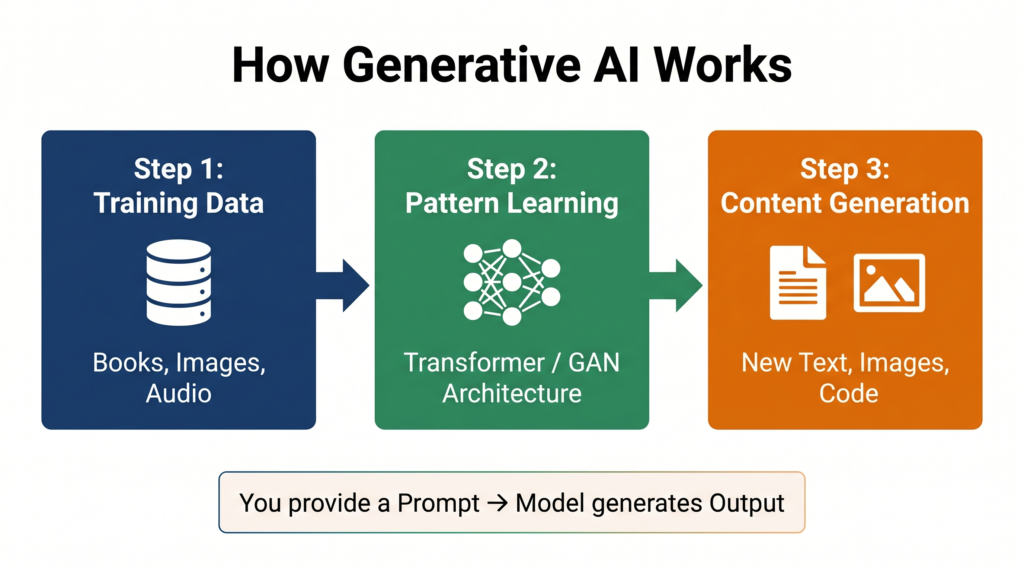
Once trained, when you give the model a prompt (an instruction or input), it uses these learned patterns to generate a new output that fits the prompt.
Here is the process in three steps:
Step 1 — Data Input (Training) The model is fed enormous quantities of data. A text model like GPT is trained on books, websites, and articles. An image model like Stable Diffusion is trained on image-text pairs.
Step 2 — Pattern Learning Using a neural network architecture (most commonly a Transformer for text, or a GAN for images), the model learns the underlying structure of the data — grammar rules, visual styles, tonal qualities.
Step 3 — Content Generation Given a new prompt, the model predicts and assembles an output token by token (for text) or pixel by pixel (for images) — generating something new but consistent with what it learned.
📗 Class 12 Note: Two of the most important architectures for Generative AI are GANs (Generative Adversarial Networks) — where two networks (Generator and Discriminator) compete to produce increasingly realistic outputs — and Transformer-based models — the foundation of all modern LLMs. You do not need to memorise mathematical details, but you should be able to name these architectures and describe their basic roles.
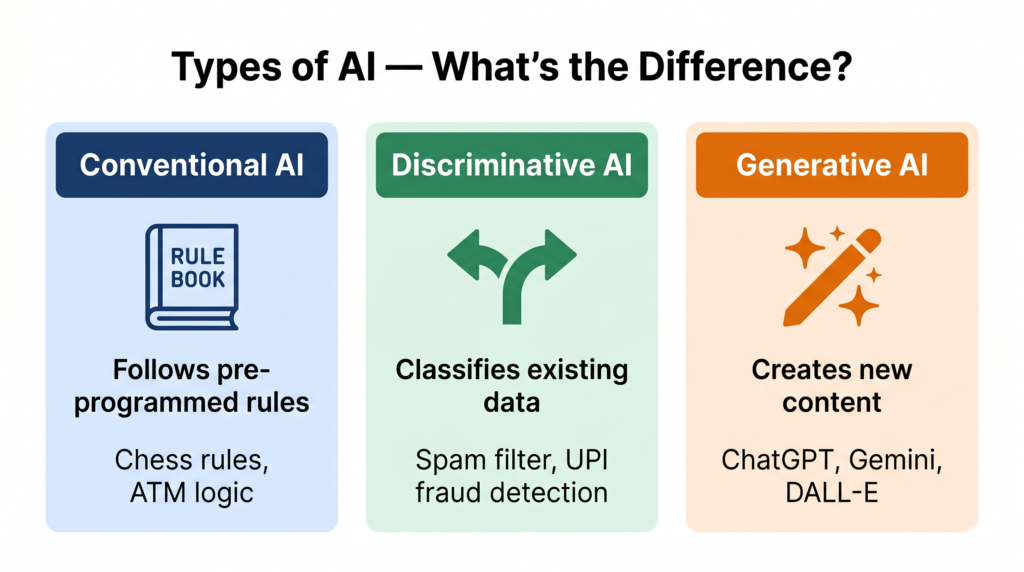
Generative AI vs Conventional AI vs Discriminative AI
This is one of the most exam-relevant comparisons in your syllabus. Class 12 students must be especially precise on Generative vs Discriminative models.
| Feature | Conventional AI | Discriminative AI | Generative AI |
|---|---|---|---|
| What it does | Follows pre-programmed rules | Classifies or predicts from existing data | Creates new content |
| Output type | A decision or action | A label or category | Text, image, audio, video, code |
| Learns from | Rules written by humans | Labelled training data | Large unlabelled or labelled datasets |
| Example task | Chess move using if-else rules | Spam detection (spam / not spam) | Writing an essay, generating an image |
| India example | ATM transaction rules | UPI fraud detection (normal / fraud) | Gemini writing a lesson plan in Hindi |
| Key model types | Expert systems | Decision Trees, SVM, Logistic Regression | GANs, Transformers, VAEs |
📗 Class 12 Exam Tip — Generative vs Discriminative Models: A Discriminative model learns the boundary between classes. Given input X, it predicts the probability of class Y. Example: given an email, it predicts P(spam | email). A Generative model learns the distribution of the data itself. It can generate new samples that look like they came from the training data. Example: given the word “Namaste”, it predicts what the next word in a sentence might be. A simple memory hook: Discriminative = Decides. Generative = Creates.
Types of Generative AI
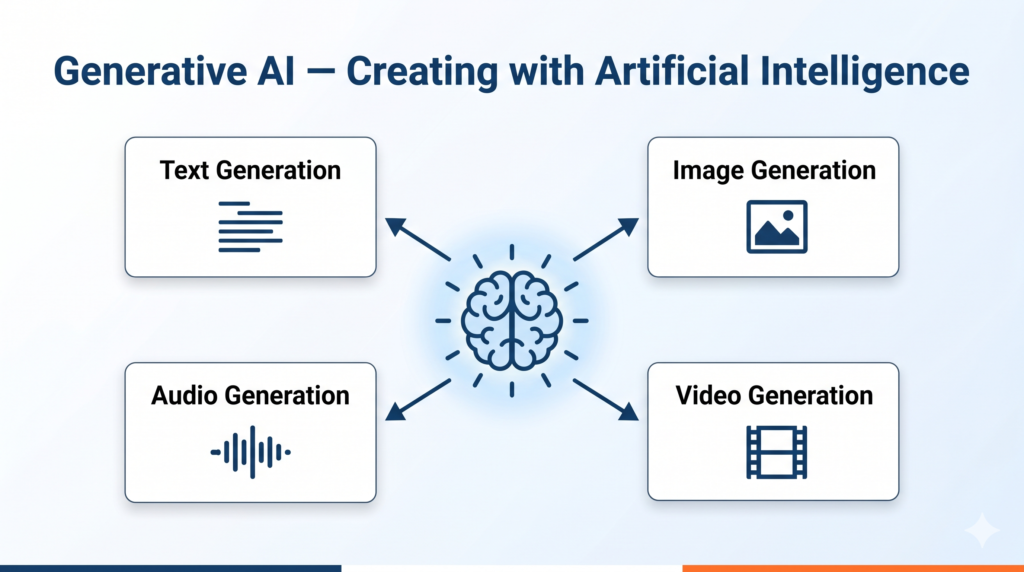
Generative AI is not one single thing — it is a family of tools that work with different types of content.
Text Generation
Models that generate human-like text based on prompts. These are the most widely used generative AI systems today. Examples: ChatGPT, Google Gemini, Claude CBSE Activity (Class 12): Use Google Gemini to craft prompts and generate text outputs; explore ChatGPT for conversational text generation
Image Generation
Models that create new images from text descriptions (text-to-image) or modify existing images. Examples: DALL-E, Stable Diffusion, Adobe Firefly, Canva AI CBSE Activity (Class 9): GAN Paint — a hands-on tool where you draw on an image and GAN fills it in realistically CBSE Activity (Class 12): Canva’s AI image generation tools
Audio Generation
Models that generate speech, music, or sound effects from text or other audio inputs. Examples: ElevenLabs (voice cloning), Suno AI (music generation), Google’s AudioLM India context: AI-generated voiceovers are now widely used in regional language YouTube channels and ed-tech platforms
Video Generation
Models that create short video clips from text prompts or still images. Examples: Animaker AI, OpenAI Sora, Runway ML CBSE Activity (Class 12): Animaker’s AI Video Generation tool
Code Generation
Models that write, explain, and debug programming code from natural language instructions. Examples: GitHub Copilot, Google Gemini in IDEs India context: Indian startups like Krutrim are building code-generation tools in local language contexts
📘 Class 9 Callout — Activity: Guess the Real Image Your syllabus includes this activity: you are shown pairs of images — one real, one AI-generated — and must guess which is which. This activity builds your intuition for spotting AI-generated content, which connects directly to the ethics section of your unit.
Large Language Models (LLMs)
(Class 12 Unit 7 sub-unit — must know for theory paper)
A Large Language Model (LLM) is a type of generative AI model specifically trained to understand and generate human language. The word “large” refers to the scale of training — billions of parameters and enormous text datasets.
How an LLM works (simplified):
- The model is trained on a vast text corpus — the internet, books, research papers
- It learns to predict the next word in a sequence, billions of times over
- Through this prediction task, it develops a rich “understanding” of language — grammar, facts, reasoning patterns, and context
- When you give it a prompt, it generates a response word by word, always predicting the most contextually appropriate next token
Key characteristics of LLMs:
- Scale: GPT-4 has an estimated 1.8 trillion parameters. Even smaller models have billions.
- Emergent abilities: As LLMs grow larger, they develop capabilities their creators did not explicitly train them for — translation, code writing, logical reasoning
- Context window: The amount of text an LLM can “see” at once. Larger context = better understanding of long documents
- Hallucination: LLMs can confidently generate false information because they are pattern-completers, not fact-checkers. This is a major limitation.
Indian LLMs to know:
- Krutrim — India’s first AI unicorn, building LLMs optimised for Indian languages
- BharatGPT / Hanooman — multilingual LLM supporting 11 Indian languages including Hindi, Bengali, Tamil, and Marathi
- AI4Bharat’s IndicBERT — open-source model for Indic NLP tasks
📗 Class 12 Advanced Learners — Gemini API Activity: Your syllabus includes writing Python code to initialise the Gemini API and create a chatbot. This is flagged For Advanced Learners and assessed in practicals only. The core concept to understand: you send a prompt to the Gemini API, and it returns a completion — the model’s generated response. Even if you do not write the code, understanding what the API does conceptually is good exam preparation.
Applications of Generative AI — With India Context
Generative AI is already transforming several sectors that directly affect everyday life in India.
Education CBSE and ed-tech platforms like BYJU’S and Vedantu are exploring AI tools that generate personalised practice questions, explain concepts in regional languages, and create study summaries. Generative AI can produce a 10-question quiz on any topic in seconds.
Healthcare Apollo Hospitals uses AI-powered tools that can generate preliminary radiology reports, helping doctors in Tier 2 and Tier 3 cities where specialist access is limited. AI is also being used to generate synthetic medical images for training diagnostic models without using real patient data.
Agriculture The government’s Digital Agriculture Mission uses AI systems that can generate advisory text for farmers in local languages — telling them when to irrigate, which pest treatment to use, and what market price to expect — based on satellite and sensor data.
Entertainment and Media Indian OTT platforms and production companies use AI to generate dubbed audio in multiple regional languages, create promotional graphics, and write social media content. Generative AI reduced dubbing costs for regional content by up to 60% in some productions.
Government and Public Services The UMANG app and DigiLocker ecosystem are exploring generative AI to answer citizen queries in natural language across 22 scheduled Indian languages — a massive accessibility challenge that only LLMs can address at scale.
Common Mistakes Students Make in Exams
Mistake 1: Confusing Generative AI with all AI Many students write “AI can create images and text” without specifying that this is a property of generative AI specifically. Conventional AI and discriminative models cannot generate new content. ✅ Correct version: Always specify “Generative AI” when describing content creation abilities.
Mistake 2: Calling GANs and LLMs the same thing GANs are primarily used for image generation; LLMs are used for text. They are different architectures. Do not use these terms interchangeably. ✅ Correct version: “GANs use a Generator-Discriminator architecture for images; LLMs use Transformer architecture for text.”
Mistake 3: Forgetting the Discriminative model definition Class 12 students often describe Generative models well but write a vague definition for Discriminative models. ✅ Correct version: “A Discriminative model learns to classify or predict labels from input data. It models P(Y|X) — the probability of a label given the input.”
Mistake 4: Listing only benefits, not limitations CBSE exam questions on this topic almost always ask for both. A one-sided answer loses marks. ✅ Correct version: Always pair every benefit with at least one limitation in any 4-mark answer.
Mistake 5: Treating ethics as optional Both Class 9 and Class 12 syllabi explicitly include ethical considerations of Generative AI. This is not background reading — it is examinable content. ✅ Correct version: Include deepfakes, misinformation, copyright, and job displacement as named ethical concerns.
Ethical and Social Implications of Generative AI
Both your Class 9 and Class 12 syllabi require you to understand the ethical concerns around Generative AI. These are organised below around the four themes most relevant to CBSE exams.
1. Deepfakes and Misinformation
Generative AI can produce hyper-realistic fake images, videos, and audio of real people. In India, deepfakes of politicians and celebrities have already been used to spread misinformation during elections. The challenge: AI-generated content is increasingly indistinguishable from real content.
2. Copyright and Intellectual Property
Generative AI models are trained on existing human creative work — books, artworks, music — often without the creator’s permission or compensation. When AI generates a painting “in the style of” a living artist, who owns that output? This is an active legal debate in India and globally.
3. Job Displacement
Content creation jobs — copywriters, graphic designers, voice-over artists, translators — are directly affected by generative AI automation. In India, where millions work in the creative services export sector, this has significant economic implications.
4. Bias and Hallucination
LLMs trained on internet data inherit the biases present in that data — gender stereotypes, regional biases, caste references. Additionally, they “hallucinate” — confidently generating false facts — which is dangerous in high-stakes domains like medicine and law.
📘 Class 9 Ethics Callout: Your syllabus specifically asks you to understand the ethical considerations of using Generative AI tools. Key questions to be able to answer: (1) Is it ethical to submit AI-generated work as your own? (2) What harm can deepfakes cause? (3) How should we verify AI-generated information?
📗 Class 12 Ethics Callout: At Class 12, you are expected to evaluate ethical, social, and legal concerns. Add these to your discussion: (1) Liability — who is legally responsible when AI generates harmful content? (2) Data privacy — generative AI models may reproduce personal data they were trained on. (3) Regulatory gaps — India’s Digital Personal Data Protection Act 2023 is still evolving to address generative AI specifically.
Try It Yourself — CBSE Activity
Class 9 Activity: GAN Paint
What it is: GAN Paint is an interactive browser tool built by MIT’s CSAIL lab where you can edit real photographs using Generative AI. You select a brush (trees, sky, clouds, brick, dome) and paint on a scene — the GAN fills in your strokes realistically.
How to do it:
- Open GAN Paint at gandissect.csail.mit.edu in your browser
- Choose any scene from the top panel (church, kitchen, bedroom, etc.)
- Select the “trees” brush and paint on a bare area — observe how the GAN generates photorealistic trees
- Now try “remove” on existing trees — the GAN fills in the background without them
- Note what looks realistic and what looks distorted — these are the current limitations of image generation
What to observe: Which elements does the GAN generate convincingly? Which look “wrong”? This tells you something about what patterns the model learned and where it fails.
For your practical file: Write 3–4 sentences describing what you tried, what the GAN generated, and one example of a realistic output and one failure — this demonstrates your understanding of both the capability and limitation of Generative AI.
Class 12 Activity: Google Gemini Prompt Engineering
What it is: Your syllabus specifically asks you to “use Google Gemini to craft prompts and generate text outputs.”
How to do it:
- Open Gemini at gemini.google.com (free account with Google sign-in)
- Start with a basic prompt: “Explain the water cycle in 3 sentences for a Class 9 student.”
- Notice the output. Now refine: “Explain the water cycle in 3 sentences for a Class 9 student. Use simple words. Include one India-specific example.”
- Compare the two outputs — the second is more specific because the prompt is more specific
- Try a creative task: “Write a short dialogue between a farmer and an AI assistant helping with crop selection in Maharashtra.”
What to document: The original prompt, the revised prompt, both outputs, and a 2-sentence observation about how prompt specificity affected output quality. This is exactly what a Class 12 viva question on “prompt engineering” will ask you to discuss.
Quick Revision Box
| Term | Definition |
|---|---|
| Generative AI | AI that creates new content (text, image, audio, video) by learning patterns from data |
| Discriminative AI | AI that classifies or predicts labels from input data; models P(Y|X) |
| Conventional AI | Rule-based AI that follows pre-programmed instructions without learning from data |
| LLM (Large Language Model) | A large-scale generative AI model trained to understand and generate human language |
| GAN (Generative Adversarial Network) | An architecture with Generator and Discriminator networks that compete to produce realistic outputs |
| Transformer | Neural network architecture used in most modern LLMs; processes text in parallel |
| Prompt | The input instruction or question given to a generative AI model |
| Hallucination | When an AI model generates confident but factually incorrect information |
| Deepfake | AI-generated hyper-realistic fake video or audio of a real person |
| Tokenisation | The process of breaking text into smaller units (tokens) that an LLM processes |
Practice Questions
2-Mark Question
Q: Differentiate between Generative AI and Discriminative AI with one example each.
Model Answer: Generative AI creates new content by learning the distribution of training data. Example: ChatGPT generates a new essay when prompted. Discriminative AI classifies or predicts labels from input data. Example: A spam detector classifies emails as “spam” or “not spam.” The key difference is: Generative AI produces new outputs; Discriminative AI assigns categories to existing inputs.
4-Mark Question
Q: Explain how a Large Language Model works. Discuss two benefits and two limitations of LLMs.
Model Answer: A Large Language Model (LLM) is trained on billions of text samples. During training, it learns to predict the next word or token in a sequence, developing an internal “understanding” of language patterns, grammar, and factual associations. When given a prompt, it generates a response token by token using these learned patterns.
Benefits: (1) LLMs can generate coherent, contextually appropriate text in seconds, dramatically reducing time needed for writing tasks. (2) LLMs can understand and generate text in multiple languages, making information accessible to speakers of regional Indian languages.
Limitations: (1) Hallucination — LLMs frequently generate confident but false information, making them unreliable for high-stakes domains like medicine or law. (2) Bias — LLMs trained on internet data inherit gender, cultural, and regional biases present in that data, which can produce harmful outputs.
MCQ
Q: Which of the following architectures is primarily used in Large Language Models for text generation?
(a) Convolutional Neural Network (CNN) (b) Recurrent Neural Network (RNN) (c) Transformer (d) Generative Adversarial Network (GAN)
Answer: (c) Transformer Explanation: Transformers process text in parallel using attention mechanisms, making them far more efficient and capable than RNNs for large-scale language tasks. GANs are primarily used for image generation.
Frequently Asked Questions
Q1. Is Generative AI the same as ChatGPT? No. ChatGPT is one application of Generative AI — specifically an LLM-based chatbot built by OpenAI. Generative AI is the broader category that includes text models (ChatGPT, Gemini), image models (DALL-E, Stable Diffusion), audio models, and video models. Calling all generative AI “ChatGPT” is like calling all social media “Instagram.”
Q2. What is the difference between a GAN’s Generator and Discriminator? The Generator creates fake content (images, text) by taking random noise as input and trying to produce realistic outputs. The Discriminator is shown a mix of real and generated content and tries to tell them apart. They train together in competition: the Generator gets better at fooling the Discriminator; the Discriminator gets better at detecting fakes. Over many training rounds, the Generator becomes capable of creating very realistic content.
Q3. Can Generative AI be wrong? Why? Yes — this is called “hallucination.” Generative AI models, especially LLMs, predict the most statistically likely continuation of a sequence. They do not verify facts against a database. So when asked about something outside their training data or at the edge of their knowledge, they generate plausible-sounding but potentially false answers. This is why LLM outputs should always be verified for factual claims.
Q4. Is using Generative AI to write my assignment considered cheating? This is an ethical and institutional question, not a technical one. At the CBSE level, submitting AI-generated work as your own without disclosure raises concerns of academic honesty. Your CBSE syllabus includes this as an ethical consideration: generative AI tools can be used for learning support (explaining concepts, generating examples, giving feedback) but not as a substitute for your own understanding and expression. Most schools are developing their own AI use policies — check with your teacher.
Q5. What careers involve Generative AI, and is it relevant for Indian students right now? Very relevant. Roles that directly involve Generative AI include: Prompt Engineer (designing effective prompts for LLMs — a new and high-paying role), AI Content Strategist (using AI tools to scale content production), AI Product Manager (building products on top of AI APIs), and ML Engineer specialising in generative models. Indian companies like Krutrim, Sarvam AI, and Navi are actively hiring in these areas. Even in non-tech careers — law, medicine, journalism, education — professionals who understand how to use and evaluate generative AI tools have a significant advantage. Your Class 9 or Class 12 AI course is genuinely ahead of the curve.
Action Plan
✅ Exam Practice Checklist
- [ ] Write a one-sentence definition of Generative AI from memory — without looking at notes
- [ ] Draw and label the GAN architecture: Generator → Fake Output → Discriminator → Real/Fake decision
- [ ] Write a comparison table: Generative AI vs Discriminative AI vs Conventional AI (3 rows minimum)
- [ ] Name three types of Generative AI with one real-world example each
- [ ] List four ethical concerns of Generative AI — include deepfakes, copyright, hallucination, and job displacement
- [ ] Practise a 4-mark answer on LLMs: how they work + 2 benefits + 2 limitations (aim for 8–10 lines)
- [ ] Review Class 12 marks allocation: Unit 7 = 7 theory marks — identify which sub-units carry the most weight
🛠 Interactive Tool
GAN Paint (Class 9) — gandissect.csail.mit.edu Paint on real scenes using AI brushes. Observe where image generation succeeds and fails. Document for your practical file.
Google Gemini (Class 12) — gemini.google.com Practice prompt engineering: write a basic prompt, then refine it with more specific instructions and compare the outputs. This directly prepares you for viva questions on how prompts affect LLM outputs.
💡 Project Idea: Fake or Real? — A Deepfake Awareness Poster Series
What: Create a 3-panel visual explainer (digital or hand-drawn) that teaches your classmates how to spot AI-generated images and text.
Step 1 — Research: Use an AI image detector (try hivemoderation.com — free tier available) to test five images: some real, some generated. Note which features the detector flags.
Step 2 — Design: Create three panels: (a) What is a deepfake and how is it made, (b) 5 visual signs that an image might be AI-generated, (c) What to do when you suspect content is fake.
Step 3 — Present: Share your poster in class or on your school’s notice board. This project connects directly to the Ethics section of both Class 9 and Class 12 syllabi and makes strong material for your practical file.