If you just moved to Class 11 and chose Artificial Intelligence as your skill subject, this class 11 ai complete guide tells you exactly what you will study, how marks are split, and which topics matter most for your practical file and Capstone Project.
What This Guide Covers
- Full Class 11 AI syllabus (Subject Code 843), 2025-26
- Unit-by-unit breakdown with key topics and exam weight
- Theory vs Practical marks — exactly as per CBSE PDF
- IBM SkillsBuild certification requirement explained
- Capstone Project and Practical File — what to prepare
- Recommended study sequence once you start
Class 11 AI at a Glance — Syllabus Overview
CBSE Class 11 AI (Subject Code 843) carries 100 marks total: 50 Theory + 50 Practical.
| Part | Component | Marks |
|---|---|---|
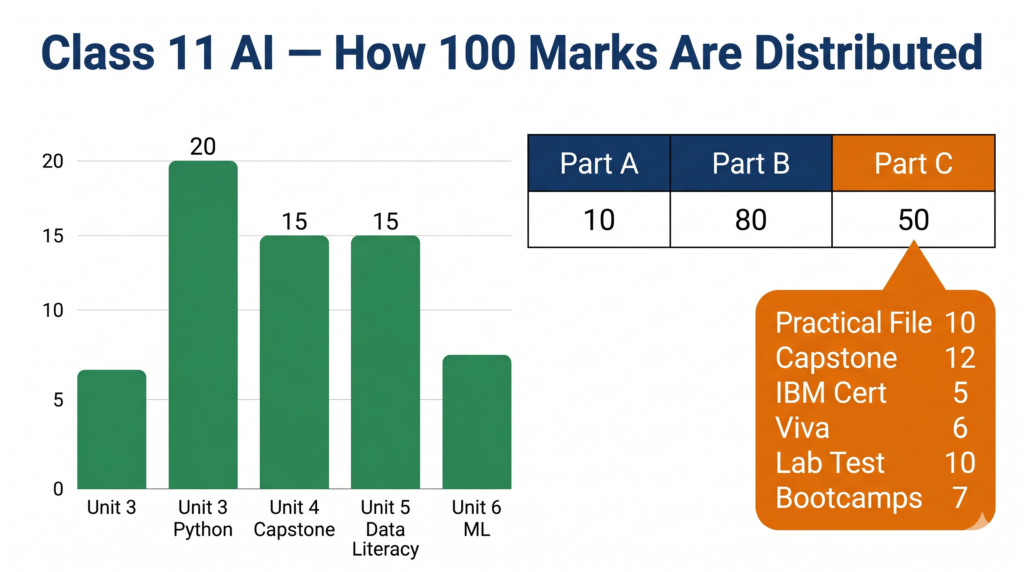
| Part A | Employability Skills (5 units) | 10 |
| Part B | Subject Specific Skills (8 units) | 40 Theory + 40 Practical = 80 |
| Part C | Practical Work / Project Work | 50 |
| Total | 100 |
Part C breakdown (50 marks):
| Component | Marks |
|---|---|
| IBM SkillsBuild Certification (or equivalent) | 5 |
| Capstone Project | 12 |
| Bootcamps / Internship / Startup Activities | 7 |
| Practical File | 10 |
| Lab Test / Written Exam (based on Practical File) | 10 |
| Viva Voce (Practical File + Project) | 6 |
| Total | 50 |
Key insight: 50 marks come entirely from what you do, not what you write in theory. Students who take the Practical File and Capstone Project seriously gain a significant scoring advantage.
Unit-by-Unit Breakdown
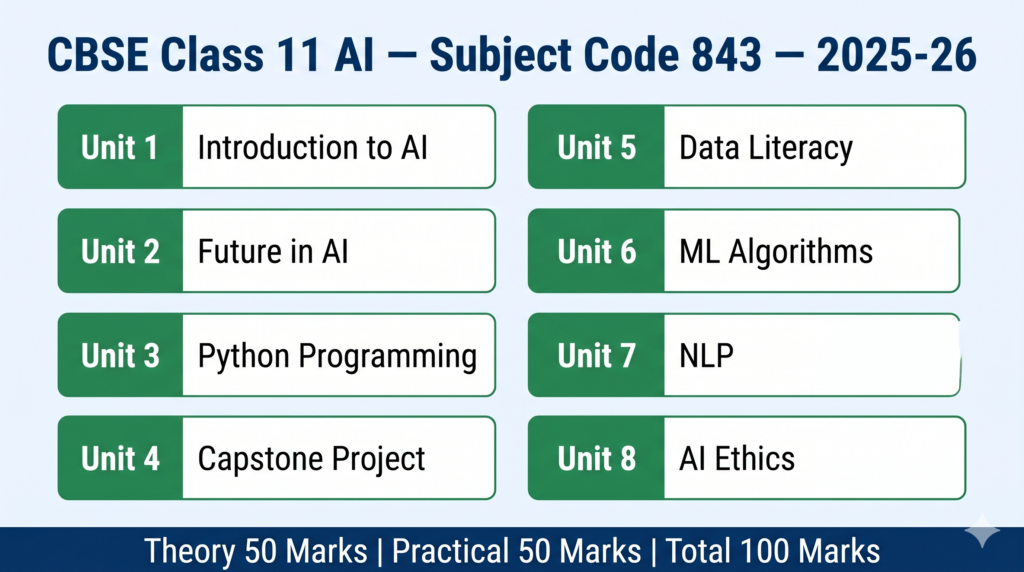
Unit 1 — Introduction: Artificial Intelligence for Everyone
Hours: 4 theory | Marks: 10 Theory + 4 Practical
This is your entry point. You will study what AI is, how it evolved, and the different types and domains of AI. Topics include the evolution of AI, types of AI (Narrow, General, Super), domains of AI (Computer Vision, NLP, Data Science), AI terminology, and the benefits and limitations of AI.
The practical activity asks you to categorise given applications into the three AI domains. IBM SkillsBuild recommends their “Introduction to AI” module for this unit — completing it counts towards your certification marks.
Deep-dive post: Introduction to AI for Class 11 — Evolution, Types and Terminologies (add link after post #150 is published)
Unit 2 — Unlocking Your Future in AI
Hours: 6 theory | Marks: 10 Theory + 5 Practical
This unit prepares you for career thinking. You will study the global demand for AI professionals, common job roles, essential skills and tools for AI careers, and opportunities across industries. The graded practical activity requires you to identify ten companies currently hiring for AI roles, then note the technical and soft skills listed by any two of those companies.
IBM SkillsBuild recommends their “Your Future in AI: The Job Landscape” module for this unit.
Deep-dive post: AI Job Roles & Required Skills (add link after post #65 is published)
Unit 3 — Python Programming
Hours: 10 theory | Marks: 20 Theory + 5 Practical
The largest theory unit in Class 11 AI. Python is taught in two levels:
Level 1 covers the basics — character sets, tokens, data types, operators, control statements (if-else, loops). You write a minimum of five programs at this level.
Level 2 covers libraries — NumPy, Pandas, and Scikit-learn — along with CSV file handling. You write a minimum of five programs at this level as well.
These programs form the core of your Practical File. IBM SkillsBuild recommends their “Python for Data Science” module alongside this unit.
Practical File note: Your Practical File must contain a minimum of ten Python programs total (5 from each level). Programs are the most direct way to earn your 10 Practical File marks.
Deep-dive posts: NumPy Tutorial for Class 11, Pandas Tutorial for Class 11, Scikit-Learn Basics for Class 11 (add links after posts #55, #56, #57 are published)
Unit 4 — Introduction to Capstone Project
Hours: 6 theory | Marks: 15 Theory + 5 Practical
This unit teaches you the thinking framework behind your Capstone Project. Topics include Design Thinking methodology, Empathy Maps, alignment of problems to Sustainable Development Goals (SDGs), and the 5W1H method for problem decomposition.
The graded practical activities include creating an empathy map for a given scenario and writing a Project Abstract using the Design Thinking framework. IBM SkillsBuild recommends their “What is Design Thinking?” module.
Your Capstone Project (12 marks from Part C) must follow the CBSE IBM Projects Cookbook guidelines — the stages of Define, Understand Users, Brainstorm, Design, Build, and Test are all required in project documentation.
Deep-dive posts: Design Thinking Framework for AI Projects, How to Create a Capstone Project Abstract (add links after posts #62, #63 are published)
Unit 5 — Data Literacy: Data Collection to Data Analysis
Hours: 6 theory | Marks: 15 Theory + 6 Practical
This unit builds your ability to work with data. You will learn how to collect data, understand data types, clean data, and analyse it using basic statistical methods. Visualising data using graphs is a key practical outcome — you will use Matplotlib in Python for this.
Deep-dive post: Matplotlib Tutorial — Data Visualization in Python (add link after post #66 is published)
Unit 6 — Machine Learning Algorithms
Hours: 9 theory | Marks: 15 Theory + 6 Practical
The most technically demanding unit in Class 11 AI, with 9 hours of theory — the highest among all eight units. You will study supervised and unsupervised learning algorithms:
- Linear Regression — predicting continuous values (e.g., predicting crop yield based on rainfall data)
- K-Nearest Neighbors (KNN) — classification by similarity (e.g., classifying disease risk based on patient parameters)
- K-Means Clustering — grouping unlabelled data (e.g., clustering customers by purchase behaviour)
All three algorithms are implemented using Python with Scikit-learn. Excel-based implementation is also expected for Linear Regression.
Exam weight: Unit 6 carries 15 marks in theory and 6 marks in practicals. Questions on algorithm steps, comparison, and application come up regularly.
Deep-dive posts: Linear Regression Algorithm Explained, K-Nearest Neighbors (KNN) Tutorial, K-Means Clustering Explained (links to posts #58, #59, #60 — currently in draft)
Unit 7 — Leveraging Linguistics and Computer Science (NLP)
Hours: 5 theory | Marks: 10 Theory + 5 Practical
Natural Language Processing — how computers understand and process human language. Topics cover the complexity of human language, an introduction to NLP (including emotion detection, sentiment analysis, classification problems, and chatbots), the phases of NLP (lexical, syntactic, semantic, logical), and applications.
The graded practical activities include writing an article on IBM Project Debater and creating a functional chatbot using Google Dialogflow, Botsify, or Botpress. IBM SkillsBuild recommends their “Natural Language Processing” module.
Deep-dive post: Natural Language Processing Complete Guide (add link after post #10 is published)
Unit 8 — AI Ethics and Values
Hours: 4 theory | Marks: 5 Theory + 4 Practical
The smallest unit by marks but one of the most discussed in exams and viva. Topics include the five pillars of AI Ethics, bias awareness, sources of bias, strategies for mitigating bias, and developing AI policies.
Practical activities include the Moral Machine game, Survival of the Best Fit game, a role play on biased AI systems, and a comparative study of AI policies from different organisations. IBM SkillsBuild recommends their “AI Ethics” module.
Deep-dive post: AI Policies and Governance for Class 11 (add link after post #152 is published)
Exam Pattern — Theory vs Practical Marks
| Unit | Theory Marks | Practical Marks |
|---|---|---|
| Unit 1: Introduction to AI | 10 | 4 |
| Unit 2: Future in AI | 10 | 5 |
| Unit 3: Python Programming | 20 | 5 |
| Unit 4: Capstone Project | 15 | 5 |
| Unit 5: Data Literacy | 15 | 6 |
| Unit 6: Machine Learning | 15 | 6 |
| Unit 7: NLP | 10 | 5 |
| Unit 8: AI Ethics | 5 | 4 |
| Part B Total | 100 (theory+prac) |
Theory question format (50 marks, Part B): CBSE typically sets 1-mark, 2-mark, and 4-mark questions. Unit 3 (Python) and Unit 6 (ML) carry the highest theory marks — prioritise these for written exam preparation.
Practical assessment (50 marks, Part C): The practical marks are earned through ongoing work — your Practical File, the Lab Test, IBM SkillsBuild certification, Capstone Project, and Viva Voce. These cannot be crammed in the last week. Students who start their Practical File and Capstone Project from October onwards are consistently better placed.
IBM SkillsBuild Certification — What You Need to Know
IBM SkillsBuild is embedded in the CBSE Class 11 AI curriculum. Completing the recommended modules earns you a digital badge and counts as your certification for 5 marks in Part C.
Each of the eight units has a corresponding IBM SkillsBuild module:
| Unit | IBM SkillsBuild Module |
|---|---|
| Unit 1 | Introduction to AI |
| Unit 2 | Your Future in AI: The Job Landscape |
| Unit 3 | Python for Data Science |
| Unit 4 | What is Design Thinking? |
| Unit 7 | Natural Language Processing |
| Unit 8 | AI Ethics |
Access all modules at skillsbuild.org. Modules are free. No signup fee. The digital badge you earn can be included in your Practical File to support your certification marks.
Full guide: IBM SkillsBuild Certification Guide for Class 11 (add link after post #61 is published)
Recommended Study Sequence
Start from Unit 1 and move sequentially — the units are designed to build on each other. However, some parallel tracks are worth noting:
Start early (from June–July): Your Practical File programs and IBM SkillsBuild certifications should begin from the first month itself. Waiting until November will mean rushing 10+ programs and six certification modules in exam season.
Concurrent with class: Follow your teacher’s unit sequence for theory. As each unit progresses in class, write the corresponding Python programs and complete the IBM SkillsBuild module for that unit.
October onward: Begin your Capstone Project in earnest. The project has 12 marks and requires documented stages — Define Problem (SDG-aligned), Empathy Map, Brainstorm, Design, Build Prototype, Test Solution, Create Video Pitch. Each stage must be documented as per the IBM Projects Cookbook format.
Exam season (Jan–Feb): Focus on Unit 3 (Python — 20 marks), Unit 4 (Capstone — 15 marks), Unit 5 (Data Literacy — 15 marks), and Unit 6 (ML Algorithms — 15 marks). These four units together carry 65 of the 100 theory marks.
Class 11 vs Class 12 — What Changes Next Year?
Students often ask whether Class 12 AI (also Subject Code 843) is significantly harder. Here is the honest picture:
Class 12 builds directly on Class 11. Python deepens — NumPy, Pandas, and data handling are recapped, and the Capstone Project becomes the centrepiece assessment at 25 marks. New topics added in Class 12 include Data Science Methodology, Computer Vision (Making Machines See), AI with Orange Data Mining Tool, Big Data and Hadoop, Neural Networks, Generative AI, and Data Storytelling.
The conceptual foundation you build in Class 11 — especially Python, ML algorithms, and the project cycle — determines how smoothly you move through Class 12.
FAQ
Q1. Is Class 11 AI (843) difficult for students from a non-science background? The Class 11 AI curriculum is designed for students from any stream. Python programming starts from the absolute basics (printing, variables, data types), and the ML algorithms are taught conceptually with tools like Scikit-learn doing the heavy computation. If you are willing to practice regularly, background does not matter.
Q2. How many Python programs are needed in the Practical File? The CBSE PDF specifies a minimum of five programs from Level 1 (basics) and five from Level 2 (NumPy, Pandas, Scikit-learn) — ten programs in total. Most schools expect more. Check with your teacher for your school’s minimum requirement.
Q3. What exactly is the Capstone Project and how is it graded? The Capstone Project is a real-world AI problem-solving project you build in a team. It must be aligned to a Sustainable Development Goal. Grading (12 marks) is based on the project itself plus documentation covering the full Design Thinking cycle. Your school’s internal examiner assesses it. A separate 6-mark Viva Voce is based on your project and Practical File.
Q4. Does the IBM SkillsBuild certification have an exam? Each IBM SkillsBuild module ends with a short assessment (usually multiple-choice). Passing it earns your digital badge. There is no separate written exam — the badge is your proof of completion and is included in your Practical File.
Q5. What kind of AI job roles can a Class 11 student start exploring? Unit 2 of the curriculum answers this directly. Entry-level roles in AI include Data Analyst, ML Engineer, NLP Engineer, Computer Vision Engineer, and AI Research Assistant. India’s job market is growing rapidly in data and AI — companies like Infosys, TCS, Wipro, Flipkart, Ola, and startups funded through the IndiaAI Mission are actively hiring. The skills you are building in Class 11 — Python, data handling, ML basics — are the exact foundation these roles require.