Most Class 9 students open their AI textbook in October and realise they have no clear map of where everything fits. This guide is that map — every unit, every marks-carrying topic, every practical requirement for CBSE Artificial Intelligence (Subject Code 417), Class IX, Session 2025-26.
What This Guide Covers
- Complete Class 9 AI syllabus structure with unit-wise marks
- What each unit actually covers and what you need to do in it
- Theory vs practical marks split — exactly from the CBSE PDF
- What goes into your Practical File and Project Work
- Recommended study sequence for maximum exam performance
Class 9 AI at a Glance
CBSE Artificial Intelligence for Class 9 carries Subject Code 417. It is a skill subject worth 100 marks total — split equally between theory (50 marks) and practical (50 marks).
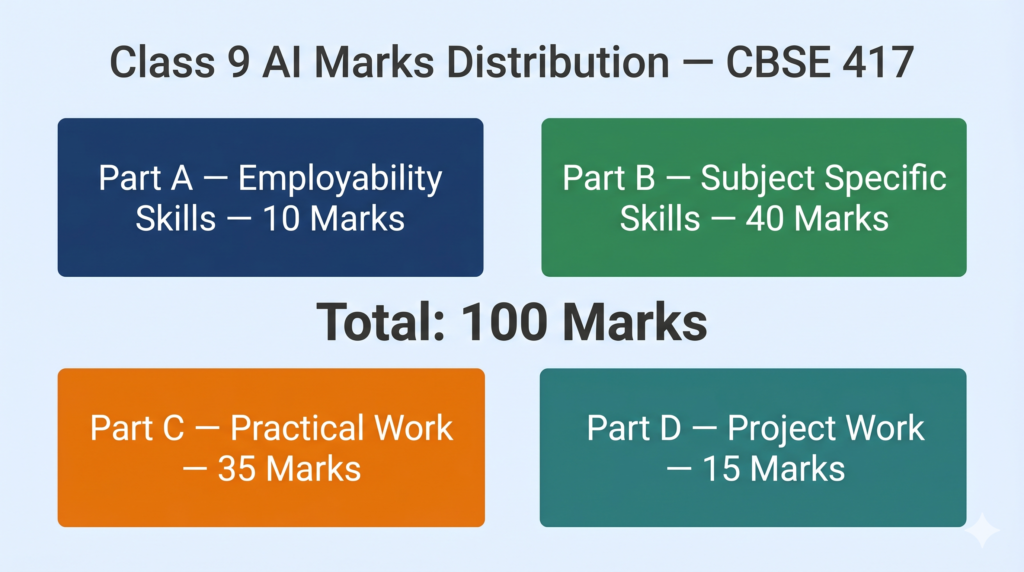
The subject is structured across four parts:
| Part | Component | Marks |
|---|---|---|
| Part A | Employability Skills (5 units) | 10 |
| Part B | Subject Specific Skills (5 units) | 40 |
| Part C | Practical Work (Python File + Exam + Viva) | 35 |
| Part D | Project Work / Field Visit / Portfolio | 15 |
| Total | 100 |
The core content that will carry your exam score lives in Part B (40 marks) and Parts C + D (50 marks combined). Part A Employability Skills — Communication, ICT, Green Skills — contributes 10 marks and is assessed separately through CBSE’s Employability Skills curriculum, which your school manages.
Part B — Unit-by-Unit Syllabus Breakdown
Unit 1: AI Reflection, Project Cycle and Ethics — 10 Marks
This is the largest unit in Class 9 AI and the right place to begin your preparation. It runs for 55 combined theory and practical hours and contributes 10 marks to your theory assessment.
What this unit covers:
AI Reflection — Understanding what Artificial Intelligence is and how it shows up in your daily life. You will engage with three AI domains: Data and Statistics, Computer Vision, and Natural Language Processing. CBSE introduces these through three hands-on games — Rock Paper Scissors AI (data-based), Semantris (NLP-based), and Quick Draw (computer vision-based). These are not optional activities — they are part of your learning outcomes and can appear in viva questions.
AI Project Cycle — The structured process for building an AI solution: Problem Scoping → Data Collection → Modelling → Evaluation → Deployment. You need to understand each stage and its purpose, not just list them. Problem scoping includes identifying stakeholders, defining the 4Ws (Who, What, Where, Why), and understanding why AI projects are iterative rather than linear.
AI Ethics — Bias, fairness, access, and accountability in AI systems. You will explore how AI systems can reflect the biases in the data they are trained on, and why questions of transparency and accountability matter — especially in contexts like healthcare, policing, and education. CBSE expects you to apply ethical thinking to your own Capstone Project. In India, examples like UIDAI’s Aadhaar facial recognition system raise exactly these questions: who is included in the training data, who gets misidentified, and who bears accountability when the system fails?
What examiners look for in this unit: Students who can explain the Project Cycle stages in the correct order, describe one real-world application for each AI domain, and identify at least two ethical concerns for a given AI scenario.
Unit 2: Data Literacy — 10 Marks
Data Literacy covers how data is collected, organised, cleaned, visualised, and interpreted. This unit runs for 50 combined hours and contributes 10 marks.
What this unit covers:
- Types of data (structured vs unstructured, primary vs secondary)
- Data collection methods and sources — surveys, sensors, public datasets
- Data quality: what makes data good, what makes it biased or incomplete
- Data visualisation: bar graphs, pie charts, histograms, scatter plots — how to choose the right graph for the right question
- Using online tools like the Data Visualisation Catalogue to explore graph types
A practical activity built into this unit is the Top 10 Song Prediction exercise — students use data about songs (tempo, genre, plays) to understand what features might predict popularity. This is an early introduction to the idea that data tells stories if you know how to read them.
India connection: India’s Open Government Data platform (data.gov.in) hosts hundreds of real datasets — school enrolment by state, crop yield by district, air quality by city. Class 9 AI students are encouraged to explore this kind of public data for their projects rather than using generic foreign datasets.
Unit 3: Math for AI — Statistics and Probability — 7 Marks
This unit is shorter (25 combined hours) but mathematically specific. It contributes 7 marks and is often where students lose marks unnecessarily because the concepts look simple but the calculations are tested precisely.
What this unit covers:
- Mean — sum of all values divided by the count; used in regression and data summarisation
- Median — the middle value in an ordered dataset; more robust to outliers than mean
- Mode — the most frequently occurring value; used in categorical data analysis
- Variance — how spread out values are from the mean; foundational for understanding model error
- Standard Deviation — the square root of variance; the most commonly used spread measure in AI
- Probability — the likelihood of an event occurring; the mathematical foundation for how AI models make predictions
Each of these is a separate learning outcome in the CBSE PDF. Do not treat them as a list to memorise — treat them as six separate topics, each with its own formula, its own meaning, and its own exam question type.
Common exam error: Students calculate mean, median, and mode correctly but cannot explain why an AI system would use one over another. Always connect each measure to its use case.
Unit 4: Introduction to Generative AI — 5 Marks
This is the newest unit in Class 9 AI, added in 2024-25 and continuing in 2025-26. It runs for 20 combined hours and contributes 5 marks.
What this unit covers:
- What Generative AI is and how it differs from traditional AI (which classifies or predicts — Generative AI creates)
- Types of generative outputs: text (ChatGPT, Gemini), images (Midjourney, DALL-E), audio, video
- How Large Language Models (LLMs) work at a conceptual level — training on text, predicting next tokens, generating responses
- Practical activities: using Google Gemini for text generation, Canva for AI-assisted design, Animaker for AI video generation
- Ethical and social implications of Generative AI — deepfakes, misinformation, copyright questions, job displacement
Why this unit matters: Generative AI is the fastest-moving field in all of technology right now. India’s government has committed ₹10,372 crore to its IndiaAI Mission specifically because the country recognises that students who understand this technology today will shape how it is used tomorrow. Class 9 is where your relationship with Generative AI becomes informed rather than passive.
The concept-focused deep dive on Generative AI is covered in the Generative AI Complete Guide — add link after post #11 is published.
Unit 5: Introduction to Python — 8 Marks
Unit 5 is almost entirely practical — 1 theory hour and 9 practical hours in class, but 8 theory marks and 35 practical marks (via Parts C and D) make this the highest-stakes section of your entire Class 9 AI year.
What this unit covers in theory:
Basic Python syntax, data types, variables, arithmetic operators, expressions, input/output functions, flow of control (if/else, loops), and Lists.
What this unit requires in practice:
Your Practical File must contain a minimum of 15 Python programs. Your Practical Examination will ask you to write any 3 programs from these categories: input/output, variables and operators, flow of control, and Lists.
For a complete guide to all 15 required programs with explanations, see the Python Programming Complete Guide.
Part C — Practical Work Marks Breakdown
Part C is assessed by your school and board examiner. It contributes 35 marks structured as follows:
| Component | Marks |
|---|---|
| Practical File (minimum 15 Python programs) | 15 |
| Practical Examination (any 3 programs from syllabus topics) | 15 |
| Viva Voce | 5 |
| Total | 35 |
What the examiner looks for in the Practical File: Programs must be correctly written, tested, and output-verified. Each program entry should include: the program objective, the code, and the output screenshot or printout. Neatness and organisation matter — examiners assess this as evidence of systematic work habits.
What the Viva covers: Expect questions on: what each program does and why you wrote it that way, any unit from Part B (especially Unit 1 Ethics and Unit 4 Generative AI as they are new additions), and your understanding of the AI Project Cycle in relation to your project.
Part D — Project Work — 15 Marks
Part D carries 15 marks and is where Class 9 students get the most creative scope of the entire year.
You must complete one of the following:
- An AI Project (most common choice)
- A Field Visit with documentation
- A Student Portfolio
AI Project requirements:
- Must be aligned with one or more Sustainable Development Goals (SDGs) — e.g., SDG 3 (Good Health), SDG 4 (Quality Education), SDG 13 (Climate Action)
- Must follow the AI Project Cycle: Problem Scoping → Data → Model → Evaluate
- Must be documented with a problem statement, data sources, approach taken, and reflection
Ideas for SDG-aligned Class 9 AI projects — crop disease detection for SDG 2 (Zero Hunger), air quality alert systems for SDG 13 (Climate Action), school dropout prediction for SDG 4 (Quality Education) — are covered in the Class 9 AI Project Ideas guide — add link after post #26 is published.
Exam Pattern — Theory Assessment
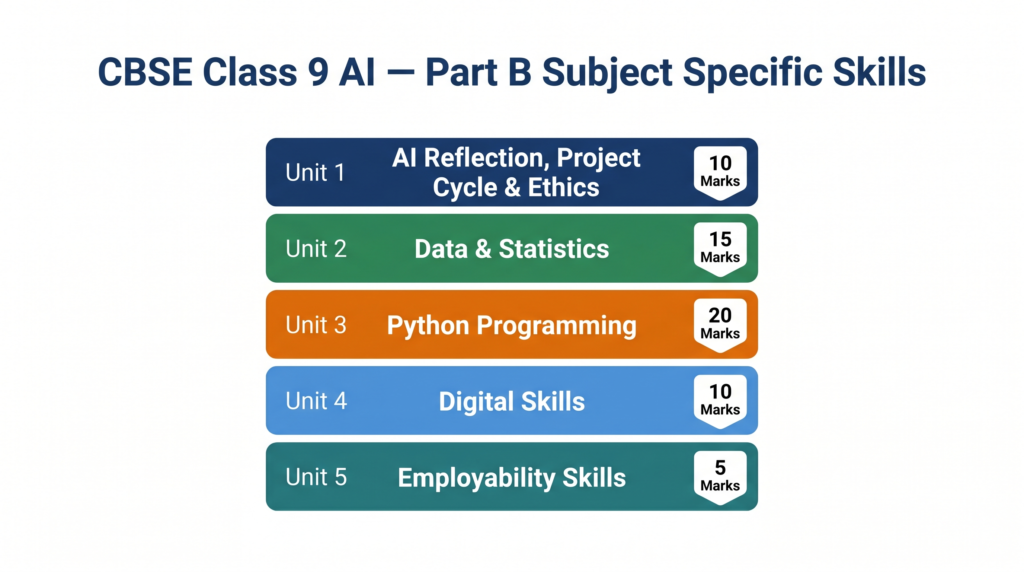
The theory exam for Part B carries 40 marks distributed across 5 units. While CBSE does not publish a unit-wise question pattern for Class 9, marks allocation by unit provides a clear priority guide:
| Unit | Marks | Priority |
|---|---|---|
| Unit 1: AI Reflection, Project Cycle and Ethics | 10 | Highest |
| Unit 2: Data Literacy | 10 | Highest |
| Unit 3: Math for AI — Statistics & Probability | 7 | High |
| Unit 4: Introduction to Generative AI | 5 | Medium |
| Unit 5: Introduction to Python (theory only) | 8 | High |
Typical question types in Class 9 AI theory:
- 1-mark questions: definitions, fill in the blanks, true/false on AI Project Cycle stages
- 2-mark questions: explain a concept with an example (e.g., “What is data bias? Give one example.”)
- 3-mark questions: compare two concepts or describe a process (e.g., “Explain three stages of the AI Project Cycle.”)
- 4-5 mark questions: apply a concept to a scenario, especially in Unit 1 (ethics) and Unit 2 (data analysis)
What Unit 1 examiners consistently reward: Students who can apply the 4-frame ethical analysis — stakeholders affected, potential bias introduced, transparency of the system, and who is accountable when something goes wrong. A student who writes all four frames for any given AI scenario (CCTV surveillance in schools, Aadhaar verification, hospital diagnostic AI) will score higher than a student who only states that “AI can be biased.”
Recommended Study Sequence for Class 9 AI
If you are starting your preparation now, work through the units in this order — not the order they appear in the textbook:
Step 1 — Unit 1 (AI Reflection + Project Cycle + Ethics): Understand the full landscape first. Every other unit connects back to this one.
Step 2 — Unit 5 Python basics: Start your Practical File early. Do not leave 15 programs for the last week.
Step 3 — Unit 2 (Data Literacy): Read the unit, then practice reading actual datasets — even simple ones like your school’s attendance register as a spreadsheet.
Step 4 — Unit 3 (Math for AI): Work through each statistical measure with a calculator and real numbers. One example per concept is not enough — do at least three.
Step 5 — Unit 4 (Generative AI): This is the most modern content. Engage with it actively — use Google Gemini, try Canva AI features — before your exam so questions about it feel familiar rather than abstract.
Step 6 — Project Work: Begin by the end of the first term. Projects done in the final two months are always rushed and always score lower.
Frequently Asked Questions
Q1. Is Class 9 AI difficult compared to other skill subjects?
Not inherently — but it requires a different kind of preparation than most subjects. The theory is conceptual and application-based rather than factual recall. The practical is hands-on Python coding, which takes consistent practice over weeks, not cramming over days. Students who start both early consistently outperform those who treat it like a memorisation subject.
Q2. My school has not started Unit 4 (Generative AI) yet. Should I study it on my own?
Yes — and it is one of the easiest units to self-study because you can use the tools directly. Spend 30 minutes with Google Gemini, another 30 with Canva AI features, and read the CBSE learning outcomes for Unit 4. That is sufficient foundation for any exam question on this unit.
Q3. What exactly should my Practical File look like?
Your Practical File is a physical or digital record of at least 15 Python programs. Each entry should have: (1) program title and objective, (2) the complete code written or printed neatly, (3) the output — either a screenshot pasted in or the output printed. Programs must cover all four categories: PRINT/output, INPUT, arithmetic operations, and Lists. Do not submit a file where programs are copied without outputs — examiners check this.
Q4. Does the AI Project in Part D need to actually use AI tools?
CBSE’s expectation at Class 9 is that the project follows the AI Project Cycle process — not that you build a working AI model. Problem scoping, data collection, identifying what kind of model would help, and reflecting on ethical implications is sufficient. If you do use a tool like Teachable Machine or a simple Python program, that strengthens the project but is not a requirement at Class 9 level.
Q5. Will understanding Class 9 AI actually help me in Class 10 and beyond?
Every unit in Class 9 AI directly prepares you for Class 10. The Project Cycle you learn in Unit 1 becomes the foundation for Class 10’s advanced modelling. The data literacy from Unit 2 feeds into Class 10’s statistical analysis and Computer Vision units. The Python basics from Unit 5 expand into advanced Python in Class 10. Class 9 is not a standalone subject — it is the foundation layer for a four-year sequence that ends with Class 12.
The student who maps their Class 9 AI year clearly — every unit, every marks-carrying component, every practical deadline — will find that nothing in the exam catches them off guard. This guide is that map. Use it.