
Class 12 is the year it all comes together — and if you’re studying AI as your skill subject, you’re already ahead of most students. But knowing what to study, how much each unit is worth, and how the exam works is what separates a 70-scorer from a 90-scorer. This guide covers every unit, every mark, and every resource you need for CBSE Class 12 AI (Subject Code 843), Session 2026-27.
What This Guide Covers
- The complete Class 12 AI syllabus broken down unit by unit
- Exact theory and practical marks for each unit (straight from the CBSE PDF)
- How the exam is structured — theory, practical, Capstone, viva
- Which units carry the most marks and where to focus
- A recommended study sequence to work through the year
- Links to the best resources on this site for each topic
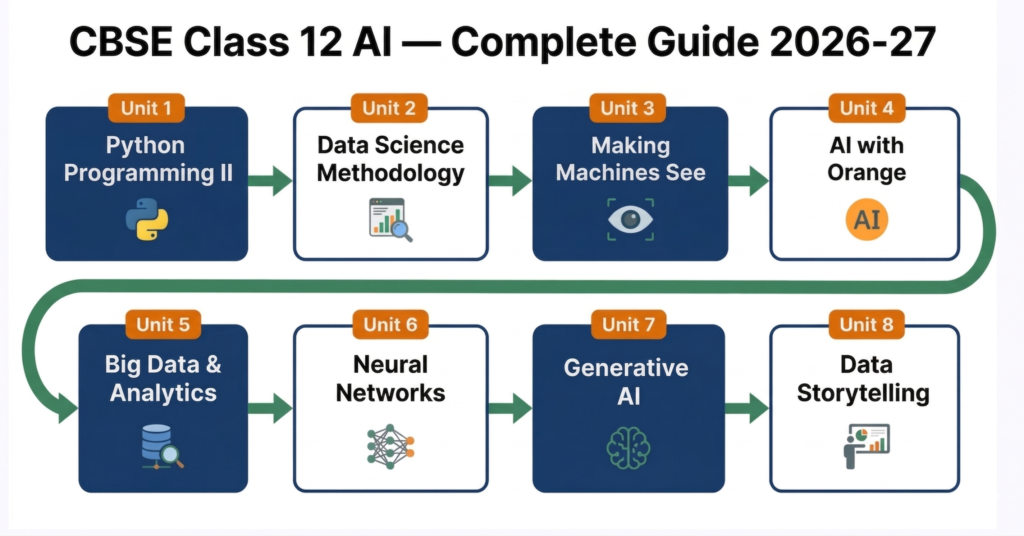
Class 12 AI Syllabus at a Glance (Session 2026-27)
Class 12 AI (Subject Code 843) is a 100-mark subject split equally between theory and practical work.
Total Marks: 100 = Theory 50 + Practical 50
The syllabus has three parts:
Part A — Employability Skills (10 marks theory) These are the five standard CBSE employability units (Communication Skills IV, Self-Management Skills IV, ICT Skills IV, Entrepreneurial Skills IV, Green Skills IV), worth 2 marks each. These are common to most CBSE skill subjects — prepare them but do not over-invest time here.
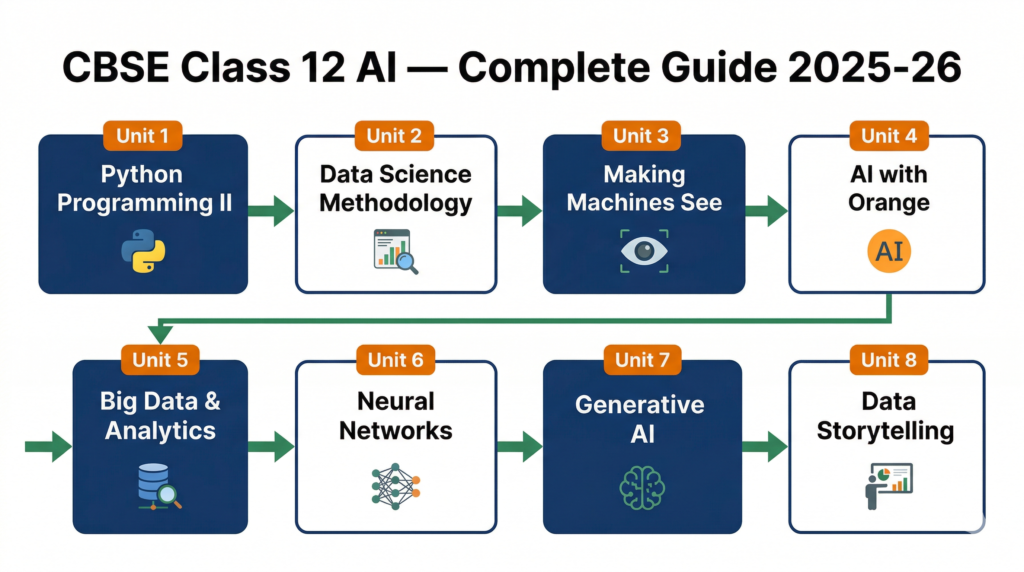
Part B — Subject Specific Skills (40 marks theory + practicals) This is where the real AI learning happens. 8 units, covering Python, Data Science, Computer Vision, Neural Networks, Generative AI, and more.
Part C — Practical Work / Project Work (50 marks) This is where Class 12 is different from Class 10. Half your marks come from hands-on work — your Capstone Project, Practical File, Lab Test, and Viva.
Unit-by-Unit Breakdown — Part B (Subject Specific Skills)
Unit 1: Python Programming – II
(Evaluated in Practicals only — not in Theory paper)
Python II builds on Class 10/11 skills. You’ll work with NumPy and Pandas to manipulate data, import/export CSV files, handle missing values, and implement Linear Regression. Note: this unit is assessed only in your Lab Test — it does not appear as questions in the theory paper.
📌 Marks: Practical only (part of Lab Test — 10 marks) ➡️ Related resource: Neural Networks & Deep Learning Complete Guide
Unit 2: Data Science Methodology — An Analytic Approach to Capstone Project
Theory: 8 marks | Practical: 12 hours | Theory Marks: 8
This unit teaches you the structured approach to solving a real-world problem using data — from defining the problem, collecting and cleaning data, to building and evaluating a model. It is directly tied to your Capstone Project, which carries 25 practical marks. Treat this unit seriously.
Key topics: problem definition, data collection, data pre-processing, model building, evaluation, deployment thinking.
📌 Why it matters: This unit directly feeds your 25-mark Capstone Project. Students who understand the methodology write better project documentation and score higher in viva.
Unit 3: Making Machines See
Theory: 6 marks | Practical: 12 hours
Computer Vision — how AI systems process and understand images. Topics include image representation (pixels, RGB), image pre-processing, feature extraction, and applications like object detection and face recognition.
📌 Marks: 6 marks in theory paper ➡️ Related resource: Computer Vision — Making Machines See
Unit 4: AI with Orange Data Mining Tool
(Evaluated in Practicals only — not in Theory paper)
Orange is a no-code visual tool for building machine learning workflows. You’ll use it to load datasets, build decision trees, evaluate models with confusion matrices, and visualise results. Like Python II, this is assessed only in the Lab Test.
📌 Marks: Practical only (part of Lab Test — 10 marks) ➡️ Related resource: Orange Data Mining — Complete Tutorial
Unit 5: Introduction to Big Data and Data Analytics
Theory: 7 marks | Practical: 12 hours | Theory Marks: 6
What happens when data gets too large for normal tools? This unit introduces Big Data concepts (Volume, Velocity, Variety — the 3Vs), data analytics types (descriptive, predictive, prescriptive), and tools like Hadoop at an introductory level.
📌 Marks: 6 marks in theory paper. A reliable unit for scoring if you learn the definitions and real-world examples well.
Unit 6: Understanding Neural Networks
Theory: 8 marks | Practical: 12 hours | Theory Marks: 8
Neural networks are one of the highest-weighted theory units in Class 12. You’ll study how neurons work, how layers are structured (input, hidden, output), backpropagation, activation functions, and the difference between ANNs, CNNs, and RNNs.
📌 Marks: 8 marks in theory — the joint highest theory unit alongside Data Science Methodology. Do not skip this. ➡️ Related resource: Neural Networks & Deep Learning Complete Guide
Unit 7: Generative AI
Theory: 6 marks | Practical: 12 hours | Theory Marks: 7
Generative AI covers how AI creates new content — images, text, audio, video. Topics include GANs (Generative Adversarial Networks), Large Language Models (LLMs), text-to-image tools, and ethical considerations around synthetic content.
📌 Marks: 7 marks in theory paper. This is a newer unit with strong exam potential — understand the concepts and real-world examples.
Unit 8: Data Storytelling
Theory: 5 marks | Practical: 4 hours | Theory Marks: 5
Data Storytelling is about communicating insights through visualisations and narrative. Topics include choosing the right chart, designing a data dashboard, and structuring a data-driven presentation. This unit connects to your Capstone Project’s video presentation.
📌 Marks: 5 marks in theory. Short unit — prepare it thoroughly since marks-per-hour investment is high.
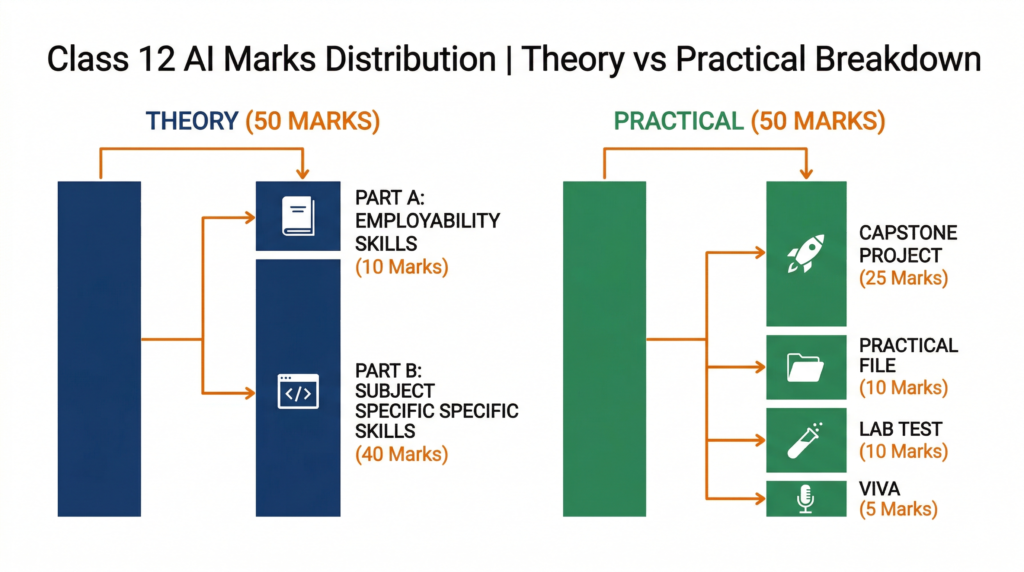
Exam Pattern — Theory Paper (50 Marks)
| Section | Type | Marks |
|---|---|---|
| Part A | Employability Skills | 10 marks |
| Part B | Subject Specific Skills (Units 2–3, 5–8) | 40 marks |
| Total | 50 marks |
Important: Units 1 (Python II) and 4 (Orange) are NOT tested in the theory paper — they are practical-only units.
Part B unit-wise theory marks at a glance:
| Unit | Topic | Theory Marks |
|---|---|---|
| Unit 2 | Data Science Methodology | 8 |
| Unit 3 | Making Machines See | 6 |
| Unit 5 | Big Data & Data Analytics | 6 |
| Unit 6 | Understanding Neural Networks | 8 |
| Unit 7 | Generative AI | 7 |
| Unit 8 | Data Storytelling | 5 |
| Total | 40 |
Practical Marks — How 50 Marks Are Split
| Component | Marks |
|---|---|
| Capstone Project + Documentation + Video | 25 |
| Practical File | 10 |
| Lab Test (Python + Orange) | 10 |
| Viva Voce | 5 |
| Total | 50 |
What this means for your preparation: The Capstone Project alone carries 25 marks (25% of your total score). This is not something you can prepare in the last week. Start planning your project in the first month of the session. Choose a problem statement early, use the Data Science Methodology from Unit 2 as your framework, and document everything as you go.
Recommended Study Sequence for Class 12 AI
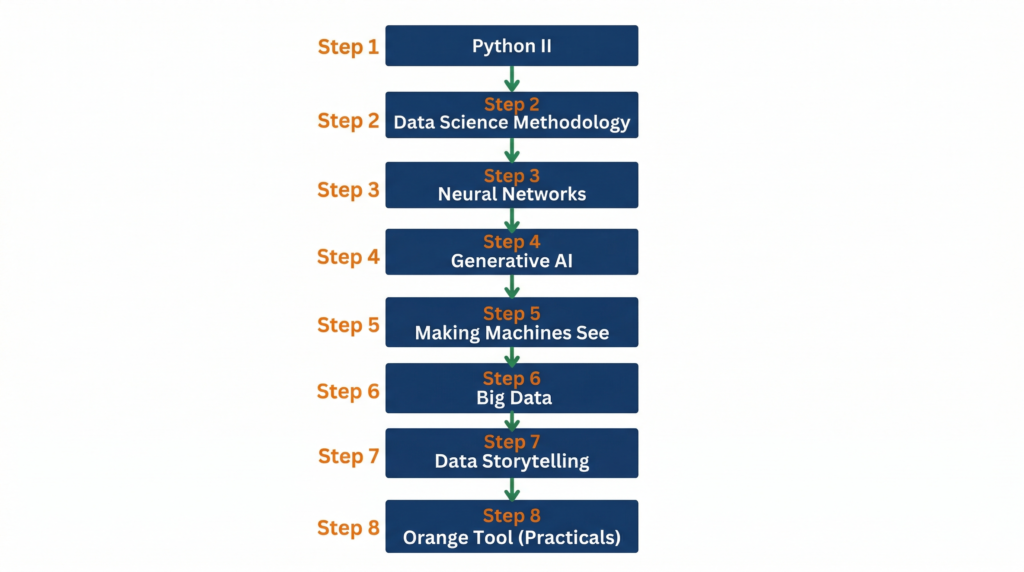
Use this sequence to plan your year. Heavy-theory units first, tool-based practical units in parallel.
- Unit 2: Data Science Methodology — Do this first. It frames everything else and guides your Capstone Project.
- Unit 6: Neural Networks — Highest theory marks. Build conceptual clarity early.
- Unit 7: Generative AI — Interesting content with 7 theory marks. Study while motivation is high.
- Unit 3: Making Machines See — 6 theory marks + practical. Manageable unit.
- Unit 5: Big Data & Data Analytics — Mostly definitions and concepts. Good for consolidation phase.
- Unit 8: Data Storytelling — Short unit. Prepare 2 weeks before boards for strong retention.
- Unit 1: Python II — Practicals ongoing throughout the year. Do Lab Test preparation in the final month.
- Unit 4: Orange Tool — Practicals ongoing. Prepare Orange workflows alongside Python.